New Africa initiative drives 112% growth in non-mining exports.
The Ministerio de Comercio, Industria y Turismo (Ministry of Trade, Industry, and Tourism) hosted the first Foro de Reencuentro Económico CELAC–África at the Ágora Convention Center in Bogotá on March 20, 2026. The event, held as part of a broader high-level forum, aimed to strengthen commercial and investment ties between Colombia and the African continent. During the proceedings, officials identified various sectors for potential growth, including jewelry, agricultural machinery, construction materials, software, digital marketing, and food and beverages.
Minister of Trade Diana Marcela Morales Rojas stated that the forum represents a strategic shift toward trade equity and shared economic opportunities. Over the past four years, the Colombian government has sought to diversify its market reach through economic diplomacy, trade missions, and the establishment of new logistical routes to Africa. Data from 2025 indicates that these efforts have resulted in a significant increase in non-mining and non-energy exports to the continent.
“We aim for this forum to mark the beginning of a new stage: one of strategic cooperation, trade with equity, and the construction of shared opportunities.” — Diana Marcela Morales Rojas, Minister of Trade, Industry, and Tourism.
According to ministry figures, non-mining exports to Africa reached $296.5 million USD in 2025, representing a 112% increase compared to 2024. In terms of volume, these shipments totaled 209,273 tons, a 226.8% rise over the previous year. These goods accounted for 46.6% of Colombia’s total exports to the continent, signaling a shift toward a more diversified export basket. Key products driving this growth include coffee, bananas, machinery, paper, and apparel.
The number of Colombian firms participating in this trade has also expanded. In 2025, 165 companies exported non-mining goods to Africa with values exceeding $10,000 USD, up from 145 companies in 2024. This 15.2% growth in participating firms underscores a transition toward higher value-added exports. Vice President Francia Márquez Mina noted that the economies of Latin America and Africa are complementary, offering potential for the development of new value chains and the utilization of strategic mineral reserves necessary for the global energy transition.
A central component of the forum was a business matchmaking event held on March 17 and 18. Preliminary results from the session show expected trade operations totaling $16 million USD. Nicolás Mejía, Vice President of Exports at ProColombia, characterized the results as a validation of the current market diversification plan. Since the beginning of the current administration, the government has implemented the Estrategia África 2022–2026 to strengthen socioeconomic relations with the region.
Through commercial intelligence analysis, the Colombian government has prioritized nine specific markets for its diplomatic and economic deployment: South Africa, Angola, Mozambique, Nigeria, Ghana, Senegal, Egypt, Tunisia, and Algeria. These nations serve as the primary focus for the continued implementation of the 2022–2026 strategy.
What does the name Anto<3 mean, and why is it written like that? Find out all about one of Festival Estéreo Picnic 2026’s most dynamic acts.
Anto<3 are all over the place both orthographically and musically, but in a good way. This is as Gen Z as it comes, gleefully mashing up sounds and styles in an explosion of energy, chaos and unfiltered reality. They’ll definitely start Festival Estéreo Picnic 2026 on the front foot with a shot of adrenaline to the heart.
This is full-throttle music that is relentless and breathless. Explicit and provocative lyrics take you through whirlwind mini-stories told in an effects-heavy style, underpinned by complex, energetic and throbbingly insistent rhythms.
2022’s Regañada
Charismatic singer Antonia Broderick and producer Samuel Huertas take time out to talk to us about their upcoming show at Festival Estéreo Picnic 2026. It’s immediately clear where the energy comes from – Broderick’s eyes dart around while Huertas has a laid-back drawl.
Their opinions on playing the country’s biggest music fest illustrate their personalities well. Broderick leaps in to say “So fucking excited, honestly. I think it’s going to be a really great moment for everyone,” while Huertas adds “Of course, we’ve been here as audience members too, so that’s cool, because it’s from here.”
Broderick’s take on their music is simply to reel off a list of adjectives: “ Intense, punky, hardcore, free, vulnerable.” Some of that might seem contradictory, but that’s part of the point of the band. Trying to pigeonhole them is a fool’s errand, constantly getting lost as they flit seamlessly and effortlessly between genres.
Huertas tells us that fusion is key to their sound, saying that they have “Electronica with Colombian things – a lot of trap and reggaeton, I don’t know what more. Rock, also, and emo?” The former are clear in the beats while the latter two often come through in the lyrics, with candid expressions of sadness and allusions to depression alongside a celebration of vice and hedonism.
He also has time for more classic sounds, even if repurposed and refashioned for a 2026 audience. “We also have like cumbia, but mixed with new genres. Some of our songs are really traditional, which is cool.” It’s not the first thing you’ll hear, but it comes out on repeat listens.
Playing with the idea of romance, they gleefully announce their new single: the charmingly named Romantikunt. It’s a bold name, to be sure, illustrative of how few fucks they give as to what others may think. Broderick seems to relish anglo-saxon words, liberally dropping ‘fucks’ throughout her songs.
And that iconoclastic, playful band name? It comes from the delightfulness of a peck on the cheek, as Broderick explains “The name is because I love the emoticon, it’s like a heart and I think I’m really romantic. It’s basically Anto-heart, but more cool.”
It’s a name that encapsulates the band: it’s Gen Z already-ironic emoticons, tells you they don’t give a fuck about classic forms and is jarring to see, while adding that twist of sugar that sweetens the message just enough to make Anto<3 fun.
Anto<3 play the Páramo stage at 3pm on Sunday March 22 at Festival Estéreo Picnic 2026
Though surprises are possible, polling says the front runners are Iván Cepeda, Abelardo de la Espriella, and Paloma Valencia.
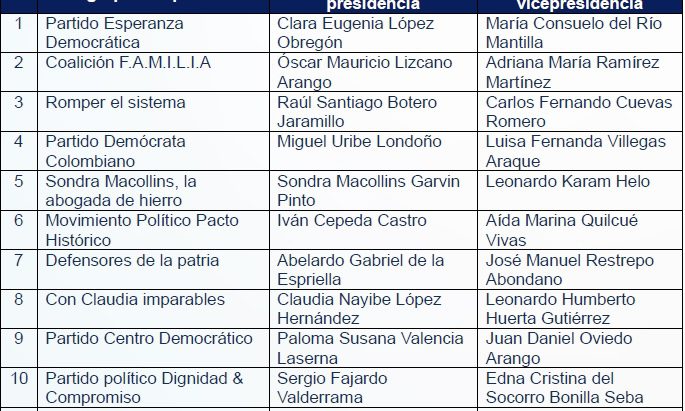
The Registraduría Nacional del Estado Civil of Colombia (RNEC), the entity responsible for organizing elections in the country, reported that a total of 14 candidates have officially registered to run in the country’s presidential elections, scheduled for May 31, 2026. In this vote, citizens will elect the President and Vice President of the Republic for the 2026–2030 term.
According to the electoral authority, the candidates represent a wide range of political perspectives, from left to right, including independent candidacies running through political movements. Here the list and brief profile of the candidates:
Clara Eugenia López Obregón, currently a senator for the Esperanza Democrática She has served as Minister of Labor (2016–2017), acting mayor of Bogotá (2011–2012), and Bogotá’s secretary of government (2008–2010). She has been affiliated with left-wing parties and was Gustavo Petro’s vice presidential running mate in the 2010 election.
Óscar Mauricio Lizcano, from the FAMILIA coalition. He served as Minister of Information Technologies (2023–2025), was a senator (2010–2018), and a member of the House of Representatives (2006–2010).
Raúl Santiago Botero, candidate of the “Romper el Sistema” movement (Break the Establishment). An agronomist engineer and businessman from Medellín, he presents himself as an independent candidate with no prior political experience.
Miguel Uribe Londoño, father of the slain presidential candidate Miguel Uribe Turbay. He is running under the Colombian Democratic Party and previously served as president of the Centro Democrático party founded by Álvaro Uribe Vélez.
Sondra Macollins Garvin, from the movement “La Abogada de Hierro” (The Iron Lawyer) A criminal lawyer and psychologist, she presents herself as an independent candidate without political affiliations. She ran for the House of Representatives in 2022 and is known for her work in narcotrafficking and corruption cases.
Iván Cepeda Castro, a senator since 2014 and the official candidate of the Pacto Histórico, the same party as President Gustavo Petro. Polls project he will receive the highest vote share in the first election round. He is aligned with left-wing political ideas.
Abelardo de la Espriella, a lawyer with far-right positions, running for the first time under the Defensores de la Patria movement. Recent polls place him as a likely second or third contender in voter preference.
Claudia López Hernández, former mayor of Bogotá (2020–2023) and former senator (2014–2018), running under the centrist movement “Imparables con Claudia.” She is known for her anti-corruption agenda and secured her candidacy with more than 570,000 votes (about 9%) in recent interparty primaries.
Paloma Valencia Laserna, current senator and candidate of the Centro Democrático party led by Álvaro Uribe Vélez. She won the right-wing interparty primary on March 8 with more than 3 million votes. Polls place her among the top three contenders, and if she reaches a runoff, she would become the first woman in Colombia’s history to do so.
Sergio Fajardo Valderrama, an academic and mathematician running for the Dignidad y Compromiso He served as mayor of Medellín and governor of Antioquia and is running for president for the third time.
Roy Barreras, from the political party La Fuerza (The Force). He won the left-wing coalition primary on March 8 with the lowest vote total (257,000 votes, about 3.6%). Although currently aligned with left-wing movements and part of the Petro administration, he has previously been affiliated with right- and center-leaning parties.
Gustavo Matamoros Camacho, of the Colombian Ecologist Party. He served in the Colombian Army for 43 years. With no prior political experience, his campaign focuses on public security.
Luis Gilberto Murillo, who served as Minister of Foreign Affairs (2024–2025) and Colombia’s ambassador to the United States (2022–2024). A human rights advocate and Afro-Colombian leader from Chocó, he presents himself as an independent, moderate, centrist candidate.
Carlos Eduardo Caicedo, running under the independent movement “Con Caicedo.” He was mayor of Santa Marta (2012–2015) and governor of Magdalena (2020–2023), where he built a strong base as a left-wing political leader.
The RNEC also reported that “the draw to determine the position of presidential candidates on the ballot will take place on March 25 at the Ágora Bogotá Convention Center.”
This process marks the formal start of the final phase of the presidential campaign, during which candidates will seek to consolidate support ahead of the first round on May 31. If no candidate secures an absolute majority, a runoff between the two leading candidates will be held on June 21.
List of registered candidates for Colombia’s presidency. Photo courtesy of the Registraduría Nacional del Estado Civil.
Headline photo: Polling station in Colombia during last Congress elections in March 8, 2026. Photo courtesy of the Registraduría Nacional del Estado Civil.
Colombia’s premier music event kicks off today, with top tier talent throughout the bill. Who’s on and what do you need to know about Festival Estéreo Picnic 2026?
Festival Estéreo Picnic 2026 is here at last! By far the most high-profile event in the Bogotá musical calendar, the festival has gone from strength to strength since its return to the heart of the capital and this year is certainly no exception. The sun has even come out to say hello for Friday at least.
With music event tourism growing in popularity, Festival Estéreo Picnic 2026 is a reason to visit Bogotá for many, with floods of foreign tourists coming in from Latin America and beyond, eager to check out what a contemporary Latin music festival looks like and how rolos party.
Our guide will let you in on some talent you might not have heard of on the bill as well as give you an idea of what the festival itself is like. Whether that’s eating and drinking, transportation or even what to wear, we’ve got you covered.
How to get around Festival Estéreo Picnic 2026
First time at Festival Estéreo Picnic? First time at a major Latin event? Don’t worry, it’s a well-oiled machine that is easy to deal with. All basic transactions are done via a cashless wristband that you can pick up onsite. The system is easy to charge, use and even reclaim outstanding balance from.
Bands are usually timed so that you can flip back and forth between the two main stages (Festival Estereo Picnic and Mundo Distinto) and catch everyone as long as you don’t need to be right at the front for everyone. Getting around is usually pretty easy, with big wide paths and wheelchair access relatively well set up.
Estéreo Picnic is definitely the main stage, facing in reverse to the Rock al Parque setup, but Mundo Distinto pushes it close as a strong second stage. Many years it sees the best performances, with the likes of Fatboy Slim and Limp Biskit ripping it up in recent years.
However, for true music geek points you’ll want to get to Lago (behind the second stage) and Bosque (to the left of main stage) for smaller bands and a more intimate atmosphere. When well-supported locals are onstage, this is a lively place to be.
There’s even a beach! Sort of.
As well as the bands on the open air stages there are also a triptych of tents. These feature a range of cabaret artists – expect burlesque, drag and the like – and a revolving lineup of mostly local DJs. These are great places to dip into if you’re left cold by the stages, but expect a fierce heat inside.
In terms of refreshments you should have no problems. There’s a decent dedicated eating area and unless you go at the absolute peak time you should have no trouble finding seats. Prices are towards the higher end of Bogotá, but not at all crazy.
Offerings are similar to what you might expect to find in a food court at a mall: a bunch of big and big-ish chains plus a few smaller outlets. Vegans are usually catered to by either NoPollo or Stankov. There’ll be a craft beer stall somewhere plus a BBC van.
This is Bogotá, so make sure you pack waterproofs and suncream porque sí. You probably need at least one of them and possibly both. If you turn up in the late afternoon you can get away without the cream, but remember people burn fast at altitude.
Decent hiking waterproofs aren’t high fashion but they are very practical and with La Niña refusing to clear off, likely to be necessary. Even if you avoid the actual rainy spells, there’s a good chance of muddy patches that can quickly ruin nice trainers.
El mundo distinto is set to be sunny for the start of the weekend
If you find yourself with a long time between bands or needing a rest, there are chill out zones to relax with as well as a market featuring stalls usually run by independent brands. There will also be plenty of megacorps trying to flog stuff all over the park.
This year, it’s a three-day event. That seems like a good move, concentrating quality into a long weekend rather than stretching things over four days. Adult tickets start at COP$523,000 for a single day and are available online via Ticketmaster here.
Finally, toilets. Yes, it’s a festival, but no, they aren’t bad. Men and women are neatly separated, but make sure you bring a pack of tissues as paper is usually in short supply. The area is nice and large so no risk of anything horrible happening.
Who to watch at Festival Estéreo Picnic 2026?
Friday
Friday’s lineup starts strong
Get onsite early to check out Entreco opening the Lago stage at 4pm on the way in. They’re queer-punk iconoclasts from Cali with a long history. The crowd might be small, but the performance will be big, with plenty of charisma on stage. Manú is then over at the Bosque for some more introspective pop.
Djo and Katseye arrived at the airport together this week and they play joined at the hip – the latter on the second stage for sundown, with the former taking over on the main stage after an hour.
Then things get complicated. Six Sex will be on a minor stage, Bogotá rockcito mainstays Nicolás y los Fumadores are at the Lago and Addison Rae lights up the second stage. Digital Nuclear Transistor is worth catching in the tents if you’re a fan of dark techno.
And then Turnstile arrive at the main stage for what will be a crushing moshpit. They’re on at the right time in the right place: it’ll be intense, just as it was when they played here a few years back.
With probably the strongest single-day lineup, there’s only one place to be to see out the day as Tyler, the Creator takes to the stage at 23:15. Lorde is the warm-up on the second stage if you don’t want to be pushing to the front for the headliner.
Saturday
Old favourites return on Saturday
After Friday’s fun and games, you might be tempted to arrive late on the following afternoon. That would be a shame, because there’s some fine acts early doors. Machaka from Ecuador is an interesting take on Latin pop, Kabinett is wildly inventive alternative electronica and 31 minutos is a puppet show. Yes really, and it’ll be huge.
Perhaps one of the most Latin experiences you can have is on today: La Tigresa del Oriente. An octagenarian balladeer that defies all comparison and most description, look her up to get an idea of what’ll happen. Aora tent at 7pm, it’ll be something special.
After that, you have Tom Morello continuing to rage against the machine, but still having an early night and The Killers, who have been here before and always turn in a big set. Swedish House Mafia close out the second stage and that is likely to be bouncing, with Festival Estéreo Picnic always loving this type of slot.
Sunday
Sunday finishes on a high
The day kicks off with an absolute riot of local talent from early on, with Anto<3, Agraciada Pirineos en Llamas and Zarigüeya all opening stages. All four are exciting young Colombian talent that reward those getting onsite to see them.
Unlike anything else on the bill, Zarigüeya is proudly political without tubthumping and blending carranga rhythms into a smooth smorgasbord of styles.
Latin American maximalism is represented by Agraciada, who teams that visual style with soulful, delicate minimalist harmonies.
Macario Martínez is a Mexican viral sensation tipped to make it big while booking Travis to play Colombia early afternoon this close to the rainy season is frankly tempting fate. Then there’s the mystery of pop pixie Sabrina Carpenter, a ray of upbeat pop among an array of darker and more aggressive acts.
Those are Interpol, Deftones and Skrillex, giving a very turn of the century feel to the end of the festival. Interpol will sound like they always do, serviceable, but the other two are more interesting.
Deftones are back on track after some rocky years, gaining near-universal acclaim for this tour as more people re-evaluate their position as nu-metal pioneers. Skrillex, meanwhile, dug a furrow all of his own as the DJ metalheads love and metalhead DJs love. He’ll lean more into the former than latter to close out Festival Estéreo Picnic 2026.
Mixing Latin American maximalist visuals with a sensitive minimalist sound, Agraciada is set to light up Festival Estéreo Picnic 2026.
Huilense popster Agraciada in person screams Latin American maximalism with her outfit. Musically, though, she’s more introspective and sensitive with a deep groundswell of emotion eddying through her songs in the tradition of melancholic Latin crooners. She’s set to bring something different to Festival Estéreo Picnic 2026.
This clash of flamboyance and melancholy would be reminiscent of Morrissey were she not so easy to talk to and such pleasant company. Born Georgina Rojas Vargás, she explains where the dualism of visual maximalism and musical minimalism comes from.
“It depends on the day,” she says with regard to her flamboyant outfit and stuffed toy. “Sometimes you have to do something a bit special. The visual identity is very important for me, the maximalism. That has a lot to do with my day-to-day life too.”
She warms to the theme, explaining that when it comes to music she thinks less can be more. “I consider myself very sensitive, it’s part of my personality. I perceive everything as very intense and music permits me to express that.”
Her music is very traditional in terms of emotion and emphasis, with a heavy focus on loss, melancholy and sadness as well as dreams of love. While there’s a lot going on, it’s muted rather than flashy, allowing the vocals to take centre stage.
In the Latin tradition, it’s gentle and soulful with stripped back wistful harmonies. “I consider my music very melancholic,” she says, continuing “there’s the romanticism of salsa and ranchera as well as other traditional genres in Colombia and Mexico particularly. It’s a very Latin American mix.”
Pressed for a personal recommendation, she says that “Calor de corazón shows the intensity of my personality.” She recommends listening in 5.1 surround sound for the full effect of the aural soundscape to reach and envelop you.
She’s looking forward to being onstage at Festival Estéreo Picnic 2026 as she loves performing. “For me art is like a service, I’m inviting the audience to share something very personal from me.” She’s been in Bogotá more than enough time to pick up the accent, so she knows just how big a stage this is.
It’ll be a big affair as well – she’s turning up with full musical support. “There will be 15 musicians on stage with me, because they’re my friends and we want to put something a bit different on stage. That includes two pianos.”
Agraciada is a bundle of contrasts that triggers lots of emotions through her gentle, softcore delivery. It’s perfect music both for a warm Bogotá afternoon at Festival Estéreo Picnic 2026 or in a nice cosy bar elsewhere in la nevera.
Agraciada plays the Bosque stage on Sunday March 22 at 14:30 as part of Festival Estéreo Picnic 2026.
Singer-songwriter Zarigüeya is on a learning curve at Festival Estéreo Picnic 2026, but she’s sure of her principles. Find out why she’s not on the world’s biggest music streamer.
Sara at the Festival Estéreo Picnic press event
Singer Sara Puentes Umbarila is performing at Festival Estéreo Picnic 2026 with a musical style that’s markedly different to much of the bill.
Known as Zarigüeya, she combines a range of musical influences with an unapologetically political stance. This isn’t party politics though, instead being about principles and philosophy.
It’s not easy finding Zarigüeya online, and she readily explains why. “I’m really hard to find because I’m not on Spotify. I was, but then I took my music out of the platform. It was a political decision, because I found out the owner was investing in war and on top of that they don’t pay the artists well. So I prefer not to be part of that.”
It’s a principled stand of the type that used to be normal in music but is becoming less commonplace. “I know it’s important for artists to be easy to find, but I don’t care.” A sentiment that might resonate with the likes of Tom Morello on the bill.
Not being on Spotify means more promotion the old-fashioned way – making good music and playing it live. And there’s no bigger stage than Festival Estéreo Picnic 2026. “I’m here to learn, basically, she says, adding “I feel good, a little bit shy, anxious but I know it’s going to be really fun and special to have this chance to share this music in places where I usually wouldn’t go.”
Making the effort to find her music (on pretty much any other platform) is well worth it though. She has a beguilingly soft voice that underpins deep lyrics. While she’s certainly part of the well established Latin tradition of a singer with a guitar, there’s a lot more to her music, blending a rainbow range of rhythms and styles.
She returns again to the theme of learning as she explains how her songs differ. “I’m still figuring things out after three years as a songwriter, so I have my band and I also play alone.” That adds to the sense of whimsy that permeates her sound – as comfortable with full backing or going solo.
Carranga pops up often in descriptions of Zarigüeya and it is a part of the mix, but she draws from lots of sources. “I mean, I love carranga, it’s one of my favorite genres, but this is not intended to be 100% carranga.”
“This is music, you have a little bit of many different rhythms. It has a clear carranga inspiration but not in all the songs. Three or four have a strong influence, but many are just whatever comes [to me] in the moment, not on a strict schedule.”
It’s no surprise that this isn’t just a musical basis. “One of my biggest influences is Violeta Parra cause she has an amazing voice, she had a very free spirit and also was always trying to find songs in the fields, in the mountains, in the people. And also she was really political in her songs which is something I admire.”
It’s a departure from much of the bill, for sure. “[The audience] can expect to see something different from the rest of the lineup, because of the music and also the vibe of the show. I like to talk a lot and be very narrative.” Adding to that is a multimedia experience, with a friend illustrating live on stage and her own art also prominent as a backdrop.
Festival Estéreo Picnic 2026 isn’t her usual scene, so it’s a special opportunity. “I go to other places usually, other kinds of festivals. So in all senses it’s new to me. It’s challenging and confronting to be part of this. I was not looking for it but I think I will learn a lot.” As will you if you get to her set on Sunday, or further down the line.
Zarigüeya plays the Lago stage at 14:15 on Sunday afternoon at Festival Estéreo Picnic 2026.
The promotional window is scheduled to run from March 16 through March 22, 2026. During this period, the airline is offering base fares starting at $1 USD. These rates apply to international routes within the carrier’s network and are available across all four of the airline’s service tiers: Basic, Classic, Comfort, and Extra.
Agressive fares through Q3 2026
According to the carrier, the travel window for tickets purchased under this promotion extends from April 15, 2026, to September 30, 2026. The availability of these fares is subject to seat capacity on specific flights. The initiative follows the carrier’s broader strategy to increase its market share in the Colombian aviation sector, which is regulated by the Unidad Administrativa Especial de Aeronáutica Civil (Aerocivil) under the Ministerio de Transporte.
Arajet commenced operations in September 2022 and currently maintains its primary hubs at Las Américas International Airport in Santo Domingo and Punta Cana International Airport. The airline utilizes an all-Boeing fleet, consisting of 14 Boeing 737 MAX aircraft (NYSE: BA). The carrier’s network connects the Dominican Republic with various destinations across North America, Central America, South America, and the Caribbean. In 2023, the airline was recognized as the “Best New Airline in the World” at the CAPA Aviation Trust Summit. The airline’s operations are overseen by the Instituto Dominicano de Aviación Civil (IDAC) in its home jurisdiction. Detailed pricing and baggage policies for the current promotion are available through the company’s digital booking platform.
Colombia kicked off its electoral year with the Senate and House elections last weekend, alongside consultas for presidential runs. Who’s come out ahead?
The Colombian elections of 2026 started last week, with the Senate and Cámara finalising their seats for the next parliament. The presidential elections will take place at the end of May, with a second round in June if necessary.
The new Senate layout. Photo courtesy of the registraduría.
The presidential elections also had a hand in last week’s results, with consultas to decide on who would represent groups of candidates with similar politics. That saw Claudia López, Roy Barreras and Paloma Valencia take the honours in their respective consultas.
When all was said and done, the results showed that traditional parties and candidates had generally performed poorly, with new candidates doing well and a difference in the traditional balance of power.
So, a week on and with the dust having settled as final results come in from all over the country, who’s up and who’s down after the first Colombian elections of 2026?
Winners
It was a good day for the government, with the Pacto Histórico gaining seats and a low turnout for the leftist consulta. The Centro Democrático, too, had a good afternoon. Paloma won her consulta handily and the party overall also gained seats in borth houses.
Pacto Historico
The governing party had a spectacular Sunday, simply said. They increased their presence in both chambers and became the largest single party to boot. The Senate remains without a clear majority, but they are in a very strong position indeed, even without the former FARC combatientes’ curules.
On top of that, other results largely went their way. The leftist consulta that Cepeda was blocked from running in was a washout as the Pacto told their supporters to stay away. Prominent critics of the party from other parties such as Robledo, Miranda, Betancourt and Juvinao all crashed out as well.
While an overall majority in either house is far from within their grasp, the Senate now leans slightly more left than right, with left and centre-left senators adding up to 53. On top of that, after an often rocky government, it’s clear that they haven’t lost their base, indeed even expanding.
Paloma Valencia
A fortnight ago, Paloma Valencia’s campaign seemed to be stuttering. She was polling in single figures for first round intentions for the presidency and making few public appearances other than the mass debates for the Gran Consulta por Colombia. There was even a worry that she might suffer an upset in that consulta.
Fast forward to today and it’s a very different picture indeed. The latest polling shows her rocketing in popularity, now standing at around 20%. That’s because she picked up over three million votes in that consulta.
Then she picked the runner up in that race as her VP ticket, a smart move on her side to try and attract voters more in the centre as well as boost her in the capital. It’s not a landslide move, but it’s canny and the presidential race will likely come down to small margins.
Juan Daniel Oviedo
Technically a loser, in the sense that he was a clear second to Valencia in the Gran Consulta. However, he picked up over a million votes, paying off his mortgage and significantly outperforming expectations. He also opened the door for some new paths in his political adventure.
It had looked like his next step was to concentrate on a tilt for Bogotá mayor, having come in second last time around after another strong campaign. He then pulled a remarkable volte-face, accepting Valencia’s offer to run on her ticket.
That’s a move that puts him potentially in a different league than before, very much on the national stage now. It’s come at an enormous reputational price though, with many that voted for him feeling betrayed as he runs on a rightist ticket. He can claim that it’s centrist as much as he likes, but few see it that way.
Influencers
Electorates worldwide are losing patience with technocrats and politics as usual. That’s as true in Colombia as anywhere else, with a number of influencers running and doing fairly well. This is a trend that has been open for a while and shows no sign of slowing down.
Former adult actress Amaranta Hank won a spot for the Pacto Historico, while the White Elephant took a seat for the Partido Verde, having started out as a content creator looking to expose corruption and poor spending practices.
Safety
Despite fears of electoral violence and a turbulent run-up to election day, it was a relatively calm Sunday in the end. There was an attack on a voting centre in Meta, plus another couple of issues elsewhere, but overall it was a good sign for the upcoming presidential elections.
Losers
There were plenty of losers last week, with several high-profile candidates for the presidential race crashing out in their consultas. That saw Vicky Dávila unconvincingly claiming she wasn’t a loser and Enrique Peñalosa falling at the first hurdle again among others.
Farewell, too, for some familiar faces. Ingrid Betancourt failed to make the cut for Senate, losing her seat alongside her party. Jorge Robledo, the leftmost critic of Petro did likewise. Miguel Polo Polo unsurprisingly lost his seat as an Afro-Colombian representative, replaced by a principled lawyer, which delighted many.
In general, old parties and old faces fared poorly, with incumbency working against many. A striking exception to that was the party for ex-FARC combatants, Comunes. To their surprise, but no one else’s, they failed to meet the threshold for representation.
Roy Barreras
Standing in the leftwing consulta, Roy won in the sense that he saw off the threat from controversial former Medellín mayor Daniel Quintero. However, the Pacto campaign to not vote in consultas laid his lack of support bare.
Viejos Verdes
The Partido Verde managed to limit their losses in terms of seats, remaining at a similar level as before. However, there has been a significant change in who takes those curules. They had an open list, meaning that no-one was assured of a place.
Voters made it clear that they wanted to see new blood, with government critics Katherine Miranda and Cathy Juvinao voted out, along with Inti Asprilla and Angelica Lozano.
The old Frente Nacional
For much of the last century, the Liberales and Conservadores absolutely dominated Colombian politics. For most of this century they’ve avoided running viable presidential candidates, preferring to hold their power in the Senate, Cámara and local politics.
This time out they have taken a big hit in both houses, losing five seats between them and no longer being in the top level of voting blocs. Due to the fragmented nature of the parliament, they retain some kingmaking powers, but are a shadow of what they once were.
A big question now looms for both parties ahead of next year’s local elections. Just as the Pacto will feel they can make some big gains there, so too will the Liberales and Conservadores worry they might take more damage.
Claudia López
The former Bogotá mayor faced no real opposition in her consulta, sailing through with over 90% of the vote. However, that was 90% of not very much and she failed to get voters out to show support in the way that Valencia and Oviedo did. She faces an uphill slog from here.
Sergio Fajardo and Abelardo de la Espriella
Neither of this pair were in consultas, instead going to the second round. That’s meant they’ve been kept out of the headlines and lost momentum as well as having some unfortunate results.
The scale of the turnout for Valencia shows she’s a viable contender to Aspriella on the right and her leap in polling is matched by a significant downturn for el tigre. For Fajardo, it’s even worse: voters are largely abandoning the centre and technocratic politicians.
Trust in the system
With the governing party repeatedly questioning the openness and fairness of the elections, this was rough. There have been a number of reports coming out questioning the practices of various voting centres and plenty of allegations, particularly from the left.
On top of that, a couple of candidates were arrested on voting day with big bags of cash that were allegedly to be used in vote-buying. While corruption in electoral processes is likely nowhere near as widespread as many claim, it’s clearly still an issue, especially in rural zones.
Centrist politics
Other than Juan Daniel Oviedo, centrists had a bad day at the polls, especially the centre-right. While the Centro Democrático and Pacto Historico gained votes on the flanks of both right and left, parties close to the centre lost out.
Cambio Radical took a big hit, as did the conservatives, with Abelardo de la Espriella’s new Salvación Nacional party gaining three seats from literally nowhere. The partido de la U also lost a seat while Ahora! won another two seats. Poor turnout for the centrist consulta also means there seems to be little support on the presidential level.
What happens next?
The presidential election on May 31 is now very much the focus of attention. Iván Cepeda still leads the polls comfortably, with Paloma Valencia and Abelardo de la Aspriella splitting the rightwing vote at the moment. However, with over two months of campaigning time ahead, there is plenty of time for everything to change.
Gustavo Petro has shown little sign of intending to follow the guidelines on not campaigning, making references to Oviedo and Valencia as well as thinly-disguised references to Cepeda and so on. Expect this to continue and ever more strongly worded warnings from the registraduría to be ignored.
It’s also likely that there will be ever more rhetoric over electoral fraud, with the Pacto campaign leaning heavily into that already and working on raising awareness of the issue ahead of the voting for the first round.
There’s currently a very good chance that the presidential campaigns will get pretty ugly, with lots of negative campaigning and attack ads. There is no love lost between the candidates and plenty of bad blood on all sides. We’ll keep you up to date with things as the campaigns develop.
The move targets a high-value niche in the European bioeconomy, offering a scalable model for sustainable Amazonian exports.
The Colombian government has formally submitted a technical and scientific dossier to the European Union seeking authorization to market cacay flour as a “Novel Food.” This regulatory category governs the entry of non-traditional food products into the European market.
The submission is the first of its kind for an Amazonian product from Colombia. It follows a 2024 initiative involving the Ministry of Commerce, Industry, and Tourism and the [suspicious link removed]. The process was supported by the Sustainable Forest Territories (Territorios Forestales Sostenibles or TEFOS 3) project, a program funded by the British Embassy and the German Cooperation GIZ.
Diana Marcela Morales Rojas, the Minister of Commerce, Industry, and Tourism, stated that the application positions cacay as a strategic component of the national portfolio of high-value natural ingredients. The technical dossier was structured according to the guidelines of the European Food Safety Authority (EFSA). To meet these standards, Colombia provided evidence of safe historical consumption for at least 25 years, alongside data on nutritional profiles, safety, traceability, and sustainable production processes.
The administrative validation phase is expected to take one month, followed by a technical and scientific evaluation by EFSA that may last up to nine months. Six Colombian companies participated in the drafting of the expediente, providing technical data and validating industrial processes to demonstrate the feasibility of large-scale production under international standards.
“This step positions the cacay as a strategic ingredient within the Colombian portfolio of high-value-added natural products.” — Diana Marcela Morales Rojas, Minister of Commerce, Industry, and Tourism.
The cacay nut, native to the Amazon and Orinoquia regions, produces a seed containing up to 60% oil rich in omega-6 and omega-9. The flour, a byproduct of the oil extraction process, contains approximately 40% protein and high fiber content. Beyond its nutritional applications, the crop is integrated into agroforestry systems aimed at restoring degraded lands and promoting biodiversity.
Currently, the cacay value chain involves more than 500 peasant and indigenous families. If approved, the flour would join Colombia’s non-traditional export basket to Europe, reinforcing a bioeconomy model based on fair trade and the sustainable use of biodiversity.
We take a quick dive down Avenida Caracas where the raised railway is both a wonder and worry.
Line 1 of Bogotá’s long-awaited Metro rises above Avenida Caracas. Photo: S Hide.
For citizens used to the snail’s pace of work on their city’s infrastructure, the rapid rising of the Bogota’s Metro over their heads is something to behold.
With 11 kilometers of concrete viaduct completed, and many more clicks of columns in place, not to mention stations and interchanges emerging from the rubble, the megaobra is officially at 73% completion.
For rolos who have waited three generations for a train – the first Metro plan was made in 1942 – this advance is nothing short of a miracle.
Not everyone is happy. Last week small business owners along Avenida Caracas, the last south-north sector of the construction, took to the streets to protest the “destruction and insecurity” of their neighborhoods.
“The Metro advances. The community recedes,” said the banners the protesters hung across the formerly busy throughfare now converted into a construction site.
As is typical in Bogotá protests, it was public transport in the form of Transmilenio buses that were blocked forcing thousands of commuters to walk sections of their journey home.
Hanging on by a thread
Carlos Torres.
The protests ended, but the problems continued for Avenida Caracas.
This week the central section of the wide avenue was taken up by construction teams supporting the massive overhead beam launcher that dropped the pre-cast viaduct sections into place 15 meters above the street.
Meanwhile, car traffic was banned from the main artery while Transmilenio buses threaded their way past graffitied concrete columns. Pedestrians scurried out of the temporary bus stations and fast away from the apocalyptic scenes, more Blade Runner than Springtime in Paris.
Local shopkeepers told The Bogotá Post this week that business had never been bleaker.
“We’re hanging on by a thread,” said Carlos Torres of clothes store 80’s American World, on the corner of Calle 60. “We’ve had no financial help from the district, and takings are down by 80 per cent.”
He had been forced to suspend their health insurance payments for the last year and were struggling to pay the rent, he said.
Danger down below
Footfall had “fallen massively” said Angela Cruz on her way to a hair salon across the road, with people avoiding the dusty streets, partly from fear of robberies.
Avenida Caracas was “always a bid dodgy”, she said, but the attraction for thieves of the building works, with materials and machinery to pilfer, had increased insecurity.
“We’re worried when it’s finished the support columns and dark areas under the Metro will become full of attackers.”
That the Metro would shelter criminals was a recurring concern for residents. Concept drawings of the finished line depicted idyllic leafy walkways with pedestrians pushing prams.
But as every resident of the city already knows, any tunnel, underpass or covered area becomes a hotspot for crime.
And whereas the Metro planners had robust plans to control access to the overhead trains to ensure commuters travel in peace – in contrast to the Transmilenio where anyone can jump on or off – there were no clear plans to protect open spaces below.
“Walking home just got harder,” said Cruz.
Avenida Caracas degenerated before the Metro construction, but the work sites have added to the feeling of abandonment and attracted criminals according to residents in the area. Photo: S Hide.
Bogotá’s ‘Berlin Wall’
Similar concerns were raised recently in a speech by President Gustavo Petro when he railed against the elevated Metro plan – now near completion – as a boondoggle for property speculators and claimed that Avenida Caracas was being “destroyed by the oligarchy”.
He further suggested that the raised railway would become a “Berlin Wall, separating the rich from poor”.
Such rhetoric was not unexpected from the mandate who long championed an underground Metro, though failed to get it moving during his own term as Bogotá’s mayor (2012 to 2015). He might yet get his way; plans for Line 2, currently on the drawing board, are for an underground Metro running east west beneath the city’s wealthier northern barrios.
The final plan to build Line 1 overhead, while controversial, was taken for economic reasons and speed of construction during the second mayorship of Enrique Penalosa – the founder of Bogotá Transmilenio bus system and implacable political opponent of Petro – in 2016.
The elevated Line 1 of the Metro will be 24 kilometers – one of the longest urban light rails on the continent – and have 16 stations including 10 interchanges with the Transmilenio bendy-bus network.
Much of the line runs through poorer barrios in the south-west of the city where, even with the work unfinished, some economic benefits were being proclaimed.
Just get it done
Adenay Flores.
Thinktank ProBogotá, in a study with the Unversidad de losAndes, reported a rise in residential property values of 11 per cent in areas around Line 1. Such increases could generate investment in undeveloped pockets of the city.
In the long term, Avenida Caracas businesses were also predicting a boost from the Metro. Just not yet.
“Right now, times are hard,” said business owner Adenay Flores. He had seen profits plunge in the 18 months since construction began, he said, while painting the entrance to his Moscu pawnbrokers.
But he also recognized that the Metro was vital to the mobility of the city and could transform lives of people living in less accessible areas.
“Yes, we’ve had hardships. But this is the evolution of the city, I totally support the Metro. Once finished it will bring people back to Avenida Caracas,” he said. “But they need to get it done.”
It was a sentiment echoed by many business owners we talked to in the shadow of the concrete viaduct: torn between welcoming the future mass transit system while keeping their financial heads above water.
“We’re suffering, but we still want the Metro. It will bring better times,” Carlos Torres from the clothes shop told The Bogotá Post. “Until then, we just have to hang on.”
… but Centro Democratico bounces back, while small parties lose out in March 8 voting.
Voting in Bogotá on March 8. Participation was 48%, with the city making up 15% of overall votes cast. Photo: Registraduria
Last Sunday’s elections brought mixed results to Colombia’s capital with the left-wing Pacto Historico party cementing its position as most popular party in the city even while its main opponent the Centro Democratico showed relatively bigger gains.
With 18 Bogotá seats up for grabs in the Chamber of Representatives, the Pacto Historico, backed by President Gustavo Petro, took a majority of eight, an increase of one seat from the previous period.
And by garnering 900,000 votes the incumbent party upped its count by more than 100,000 compared to 2022, when it was also the most popular party in the city.
But by some comparisons the right-wing Centro Democratico’s result was even more impressive, surging from two to four seats on March 8, totalling 700,000 votes, up from around 300,000 in 2022.
In Bogotá, as at national level, the losers were the smaller independent parties often citizen-led or based on niche issues. Also failing was the Nuevo Liberalismo party, founded by mayor Carlos Galán, which failed to pick up a single seat, a sign perhaps of citizen discontent with the capital’s current administration.
The demise of the small and independents reflected a national trend of voter gravitation towards the two bigger parties, Centro Democratico and Pacto Historico, whose top candidates – Paloma Valencia and Iván Cepeda – are likely contenders for the presidential slug-out in May.
The remaining Bogotá seats went to smaller traditional parties the Green Alliance (2), and the Liberal Party (1), with one seat awarded to the upstart Salvacion Nacional formed by firebrand right-wing presidential candidate Abelardo De La Espriella.
Voting results for seat in the Cámara on March 8 in Bogotá. Note this is the preliminary electronic count, changes can take place after manual scrutiny of the results this week. Data: Registraduria
Political phenomenon
The stand-out result in the Bogotá caucus was Centro Democratico’s first-time congressional candidate Daniel Briceño who captured 262,000 votes for his seat in the chamber.
Not only did Briceño get the highest congressional vote across Colombia, he also out-voted the entire list of senators – which get elected nationally – with one of the historically highest ever recorded in Colombia for a camara or senado representative.
The 34-year-old lawyer was being hailed this week as a political phenomenon. Briceño is currently serving on Bogotá city council where he campaigns against corruption, cronyism and waste through a clever combination of social media and forensic takedowns of his political targets.
The influencer made his name by digging into big data on government databases that has allowed him to uncover contracts and documents embarrassing to the administration of Gustavo Petro.
Since then, he has gained both an online following and voter base by scrutinizing and exposing mismanagement at all government levels.
Rise of the influencers: Daniel Monroy, left and Laura Beltran aka Lalis , center, and Daniel Briceño, right.
Defend every vote
Briceño’s jump to congress was mirrored on the political left in Bogotá by the rise of influencers Laura Beltran, aka Lalis, and Daniel Monroy, who both won seats for Pacto Historico.
Despite their success at the urns on March 8, both Monroy and Beltran amplified claims of fraud in the days after the election.
Beltran, posting on X, issued a media alert begging for lawyers in the city to volunteer their time as scrutineers to check the recount after detecting “the winds of fraud”.
“We are defending each vote for the Pacto Historico. In Bogotá we have the chance to recover one more seat,” she said, suggesting the party could up its count to nine.
Monroy, for his part, made a widely echoed claim that “votes for Pacto Historico are disappearing”.
So far there is no evidence of electoral fraud, though changes in the final vote could come about from errors corrected in the final scrutiny taking place in Bogotá this week.
Meanwhile preliminary declarations by European Union electoral observers – 145 were deployed to Colombia – stated that the voting process had been “transparent, accurate and well-organized”.
Voter turnout for Bogotá was 48 per cent, similar to the level of participation across the country, with the capital providing 15 per cent of the national vote. A higher turnout is expected for the May presidential elections.
The new members of Congress will take office on July 20, the official start of the new legislative term.
On March 8, Colombia elected the Congress that will exercise legislative authority during the 2026–2030 term. From more than 3,200 candidates, voters chose the 102 senators (upper house) and 182 members of the House of Representatives (lower house) who will make up the country’s legislative branch.
According to preliminary reports from the Registraduría Nacional del Estado Civil (RNEC), with 98.4% of polling stations counted, equivalent to 19,220,365 votes tallied, the new Congress has been defined electorally, however, it should be noted that these seat projections correspond to the official preliminary count, which still must go through several formal procedures before the final results are certified.
How the Senate Race is Shaping Up?
The Pacto Histórico, the party of current President Gustavo Petro, obtained around 22% of the vote (4,402,601), which would allow it to increase its representation from 20 senators in the current legislature to approximately 25 seats in the next term.
In second place is the Centro Democrático, the party of former President Álvaro Uribe, with about 15% of the vote (3,020,459), potentially increasing its representation from 13 to 17 seats.
The Partido Liberal would rank third with 13 seats (2,268,658 votes). It would be followed by the Alianza por Colombia, led by the Green Party, with 10 seats (1,899,096 votes), and the Partido Conservador, also with 10 seats (1,859,493 votes).
Other wins in the Senate include Party of La U (9 seats), Cambio Radical (7), the Ahora Colombia coalition (5), which backs presidential candidate Sergio Fajardo, and Salvación Nacional (4), the movement of presidential candidate Abelardo de la Espriella. The two remaining seats correspond to the special indigenous constituency.
In terms of losses in representation, the Partido Conservador would be the most affected, losing five of its current 15 seats. Cambio Radical would lose four, the Greens three, La U two, while Liberals and Ahora Colombia would each lose one seat.
Among the prominent figures who would be left out of the new Senate is former President Álvaro Uribe, who occupied position number 25 on his party’s list and would not obtain a seat if the Centro Democrático secures only 17 seats. Green Party senator Angélica Lozano, known for promoting legislation related to transparency, would also lose her seat.
Likewise, movements such as the coalition that supported Juan Daniel Oviedo and the Partido Oxígeno, led by former presidential candidate Ingrid Betancourt, who was kidnapped for years by the now-defunct FARC guerrilla group, would fail to surpass the minimum threshold required to obtain Senate representation (3% of the total vote).
On the other hand, the performance of the Salvación Nacional movement, led by presidential candidate Abelardo de la Espriella, stands out. In its first participation in a congressional election, the party would surpass the electoral threshold and secure four senators.
What About the House of Representatives?
The allocation of seats in the House of Representatives follows a different process from that of the Senate, making it difficult to project the final distribution in the early stages of the vote count.
This is because the calculation is conducted department by department, once the RNEC determines the seat allocation formula and electoral quotient in each of the 32 States and the Capital District of Bogotá.
According to report number 45 from the RNEC, with 99.03% of votes counted, the main parties have obtained the following preliminary nationwide results:
Centro Democrático: 2,551,706 votes.
Partido Liberal: 2,101,877 votes.
Partido Conservador: 1,967,996 votes.
La U: 1,044,778 votes.
Pacto Histórico: 913,990 votes.
Cambio Radical: 803,721 votes.
Alianza Verde: 654,071 votes.
Salvación Nacional: 436,365 votes.
Because the House of Representatives elections involve parties, movements, and coalitions with strong local and regional influence, several smaller political organizations are expected to win seats, as they must surpass regional thresholds rather than a national one.
The Highlight: a Fragmented Congress that Will Require Coalitions
With the preliminary distribution of seats in both the Senate and the House of Representatives, projections suggest that Colombia’s next president will need to govern through legislative coalitions, as has occurred under President Gustavo Petro and his predecessors.
Presidential candidates Iván Cepeda, of the Pacto Histórico, and Paloma Valencia, of the Centro Democrático, would begin the next political phase with the largest congressional blocs, although neither would have enough seats to govern alone.
Traditional parties such as the Liberal, Conservador, Cambio Radical, and La U, which together could account for more than 40% of the new congress, have not yet decided which presidential candidate they will support, a situation similar to what occurred in the previous election. These parties could therefore become kingmakers, capable of facilitating, or blocking, governability depending on the alliances and coalitions they choose to form.
For that reason, the coming weeks are expected to be marked by intense political negotiations, as presidential contenders attempt to build alliances that would allow them to secure legislative support.
For candidates such as Sergio Fajardo, whose Ahora Colombia coalition would obtain only five senators, or Abelardo de la Espriella, whose Salvación Nacional movement would have four, the challenge will be significantly greater.
Above photo: Polling station during Colombia’s congressional elections. Photo courtesy of the Registraduría Nacional del Estado Civil.
Colombia’s presidential race has entered a new phase following the interparty primaries held on March 8. Three major coalitions selected their candidates ahead of the first round scheduled for May 31: Paloma Valencia (48 years) will represent the right, Claudia López (56) the center, and Roy Barreras (62) a segment of the left.
Beyond their immediate results, Colombia’s interparty primaries typically serve two main purposes: reducing the number of contenders and selecting the flagbearers of each coalition, while also measuring the electoral strength of political figures ahead of potential negotiations among parties and candidates. With 99% of polling stations counted, and preliminary results rapidly released by the Registraduría Nacional del Estado Civil, several political consequences of the vote are already emerging.
Paloma Valencia to Lead the Uribista Right
The right-wing consultation brought together nine candidates from different center-right and conservative currents. One of its main goals was to secure a strong turnout that could consolidate the sector in public opinion and counter the rise of far-right candidate Abelardo de la Espriella, who seeks to capture a portion of Colombia’s traditional conservative electorate.
The winner was Senator Paloma Valencia, who has campaigned nationwide alongside former President Álvaro Uribe Vélez, the leading figure of the Centro Democrático party.
Although polls had already projected her victory, the surprise was the scale of the result. With 99% of polling stations counted, Valencia secured 3,212,528 votes, representing more than 45% of the total votes cast across the three primaries.
She now faces three major challenges. The first will be unifying the right behind her candidacy and preventing conservative voters from drifting toward De la Espriella. In this context, the selection of her vice-presidential running mate will be crucial.
Among the names circulating is Juan Daniel Oviedo (48), a former Bogotá city councilor who unexpectedly finished second in the consultation with more than 1,200,00 votes, despite his well-known ideological differences with the Uribista movement.
The second challenge is symbolic: no woman has ever reached the second round of Colombia’s presidential election, making it difficult to break that historical barrier even with the political backing of Uribe, who still maintains strong favorability ratings.
Finally, Valencia will attempt to channel the anti-Petro vote, capitalizing on public dissatisfaction with the policies of President Gustavo Petro and his close political ally Iván Cepeda, who currently appears as the frontrunner in most polls for both the first and second rounds.
The Center Cools Around Claudia López
With 99% of votes counted, the centrist consultation recorded the lowest turnout among the three coalitions. Former Bogotá mayor Claudia López received more than 572,000 votes, representing just 8.14% of the total, well below polling projections that placed her above 12%.
For López, the result follows a long campaign that began more than a year ago, during which she sought to challenge Sergio Fajardo, the former mayor of Medellín who already holds the endorsement of the Dignidad y Compromiso party.
The key question now is her next political move: whether to remain in the presidential race or eventually join forces with Fajardo, whose polling numbers also remain modest, hovering around 5%.
The weak result may reflect the fragmentation of Colombia’s political center, often criticized for positions perceived as moderate or ambiguous. It may also indicate that Juan Daniel Oviedo attracted part of the centrist electorate within the right-wing consultation.
In any case, the outcome suggests the presidential campaign could once again polarize around two main narratives: “with Petro,” led by Iván Cepeda and the Pacto Histórico, or “against Petro,” a space still contested between Paloma Valencia and Abelardo de la Espriella.
Roy Barreras Wins the Left Consultation, but Momentum Favors Cepeda
In Roy Barreras’s case, two key factors appear to have contributed to his limited result. First was his decision to maintain a primary that many within the left considered unnecessary, given that much of the progressive sector had already rallied behind Iván Cepeda.
Second is his long political trajectory across multiple governments and ideological camps, from the right to the left, which has led some voters to view him as a traditional establishment politician.
With 99% of votes counted, Barreras secured just over 255,000 votes, less than 4% of the total. During the campaign, Barreras had stated he expected to surpass 1,500,000 votes in order to negotiate a stronger position within the left-wing coalition. Following these results, his most likely option may be withdrawing his candidacy and endorsing Cepeda, signaling unity within the progressive camp.
Other Highlights from the Electoral Day
One of the most striking outcomes was the performance of Juan Daniel Oviedo, who finished second among the 18 candidates participating in the primaries with 1,251,428 votes. With this electoral capital, Oviedo has become one of the most sought-after figures for potential alliances.
His political alignment remains uncertain. It is unclear whether he will fully integrate into Paloma Valencia’s campaign and the Centro Democrático, with whom he has ideological differences, or attempt to move closer to the weakened political center.
Unlike many traditional politicians, Oviedo has built a relatively short but distinctive political career based on his technocratic profile, his experience in economic policy, and his attempt to position himself outside the traditional Petro-Uribe political divide.
Meanwhile, journalist Vicky Dávila (52), who has run a campaign with populist elements inspired by figures such as Javier Milei in Argentina and Donald Trump in the United States, received more than 236,000 votes, around 3.3% of the total, leaving her with limited negotiating leverage.
A similar outcome affected Daniel Quintero (45), the former mayor of Medellín, who received just over 226,000 votes (around 3.2%), with his campaign likely hurt by controversies linked to alleged corruption during his administration.
Under Colombia’s electoral law (Law 1475 of 2011), political parties may still modify or withdraw candidates until March 20. After that date, the presidential campaign will move toward the first round scheduled for May 31. If no candidate obtains an absolute majority (50% plus one), the two candidates with the highest vote totals will compete in a runoff election on June 21.
For now, the race appears likely to center on a left-wing coalition led by Iván Cepeda with the backing of President Gustavo Petro, and a divided right contested between Paloma Valencia and the ultraconservative Abelardo de la Espriella.
Above photo: Claudia López, candidate in the centrist primary, casting her vote in Bogotá. Photo courtesy of Claudia López’s campaign team.
Seats are distributed using the D’Hondt method, known in Colombia as the cifra repartidora, which allocates seats proportionally according to the number of votes obtained.
A total of 3,231 candidates will compete for seats in Colombia’s congress in the legislative elections scheduled for March 8, according to the Registraduría Nacional del Estado Civil (RNEC), the authority responsible for organizing the country’s electoral processes. In total, 102 senators and 182 members of the House of Representatives will be elected.
According to the electoral authority, 1,124 candidates registered for the Senate and 2,107 for the House of Representatives, the two chambers that make up Colombia’s congress.
As the political analysis website Razón Pública explains, Colombia’s electoral system is based on proportional representation, which seeks to reflect the diversity of political opinions within society in the composition of Congress. For the Senate, or upper chamber, voters may cast their ballots for candidates anywhere in the country, as it operates under a national constituency. In contrast, the House of Representatives, or lower chamber, is elected through territorial constituencies by departments, including Bogotá as the Capital District.
According to the RNEC, 41,287,084 citizens are eligible to vote in the upcoming elections, a key figure because it influences how seats are allocated.
Senate elections
In this election, 102 senators will be chosen by popular vote. According to the Senate’s official website, 100 will be elected through a nationwide constituency and the remaining two seats are reserved for indigenous communities, a special constituency established by the 1991 Constitution to guarantee political representation for these groups.
Voters must choose between receiving the national ballot or the Indigenous constituency ballot, but they cannot vote in both.
House of Representatives elections
For the House of Representatives, 182 members will be elected, distributed as follows:
Territorial constituencies: 161 seats allocated to departments and the Capital District of Bogotá.
Special Transitional Peace Constituencies: 16 seats reserved for victims of the armed conflict, created by the Acto Legislativo 02 of 2021.
Afro-descendant communities: 2 seats.
Indigenous communities: 1 seat.
Community of San Andrés (Raizal): 1 seat.
Colombians living abroad: 1 seat.
Unlike the Senate, each department receives a specific number of seats based on its population, creating regional electoral dynamics in which local political leadership often plays a key role. In practice, more populous departments hold greater representation than smaller ones.
Both the Senate and the House of Representatives receive one additional seat after the presidential election, allocated to the candidate who obtains the second-highest number of votes.
How seats are allocated
Colombia’s electoral system is regulated by the Acto Legislativo 001 of 2003 and the Electoral Law, and operates under principles of proportional representation.
First, the valid votes obtained by each party list are counted. Only those lists that surpass a 3% threshold of total valid votes are eligible to participate in the distribution of seats. In the 2022 legislative elections, this threshold exceeded 509,000 votes.
According to projections by the Misión de Observación Electoral (MOE), the threshold for the Senate in the upcoming elections could reach around 600,000 votes.
This threshold is crucial because if, for example, a candidate obtains 450,000 votes but their party fails to pass the threshold, neither the candidate nor the party will secure a seat in Congress.
Among the lists that surpass the threshold, seats are distributed using the D’Hondt method, known in Colombia as the cifra repartidora, which allocates seats proportionally according to the number of votes obtained. In 2022, the seat-allocation quotient was 144,013 votes.
For the House of Representatives, the process is more complex because the threshold and D’Hondt method are applied separately within each department, producing different results across regions.
With closed lists, voters select only the political party or list as a whole, without choosing an individual candidate.
Open and closed lists
Under the Acto Legislativo 1 of 2003, political parties may register open lists or closed lists. With open lists, voters select a specific candidate within a party’s list. The vote counts both for the political party and for the individual candidate. Seats obtained by the party are then assigned to the candidates who received the highest number of votes, regardless of their initial position on the list.
With closed lists, voters select only the political party or list as a whole, without choosing an individual candidate. Seats are then allocated according to the order predetermined and registered at the start of the campaign by the party.
In the upcoming elections, two of Colombia’s most prominent political forces will present closed lists: the Pacto Histórico, the coalition led by current President Gustavo Petro, and the Centro Democrático, the right-wing party founded by former President Álvaro Uribe Vélez.
Photo courtesy of the National Civil Registry of Colombia,
In the north of Bogotá, a new restaurant offers an experience that exists nowhere else in Latin America.
Sombras, or ‘shadows’, is a high-end eatery run entirely by blind people, offering a unique experience that aims to raise awareness about sight loss and the challenges faced by those living with this condition.
For 90 minutes, diners are provided a sensory experience through a six-course menu while sitting in complete darkness
This project, part of the Seratta Group, costs approximately 325,000 COP (around US$88) and seats around 20 people at a time.
According to the DANE (National Administrative Department of Statistics), in 2025, the labor gap for people with disabilities was critical: roughly 80% of the population was unemployed. Of the 20% who are employed, many relied on informal work as a way of living.
Accordingly, Sombra’s primary goal is to increase job opportunities for people with visual impairment, even offering a ‘BLINDKEDIN’ on their website to promote inclusion in workspaces and bridge the gap between companies and workers.
Into the unknown
Entering the restaurant, guests are asked to place their belongings in lockers as one of the hosts voice announces, “The main ingredient is trust.” Cellphones, smartwatches, or any other distracting items are forbidden from being used in Sombras. Bags are stored as well, so as not to create obstacles as the staff move around the room unassisted.
Right ahead is the path to darkness; the atmosphere is filled with fear, expectation, curiosity, and excitement. Not knowing what lies inside, guests must simply walk into the unknown.
Taking small steps, hands over the shoulders of a man simply identified as ‘Agent X,’ diners are shown to their seat. Finally, they are left alone at a table that can only be perceived through touch.
A mix of music, played by a blind DJ, is the perfect accompaniment to the dishes and cocktails placed down one by one.
Each course is served while a voice guides the guests through the dark: “Take this, move your hand to the left.”
Scenarios described over speakers guide guests through different worlds, prompting them to reflect on how they perceive the dark. Some courses are designed to evoke childhood memories; as diners eat, the flavors, aromas, and narrations conjure up images of their grandmother’s warm soup or the salty smell of seaside holidays.
Without the visual cue of the food, flavors meld in novel ways, and everything tastes more intense.
Between courses, a sense of emptiness can settle in. While the mind tries to imagine colors, dimensions, and even the appearance of fellow diners, the silence and darkness produce a feeling of loneliness and a sense of nothingness. Time passes, but without a watch, it is impossible to measure.
One cycles through intense feelings and emotions as the brain fights to understand what is happening around it. Placed in the shoes of those who live in darkness every day, guests soon realize they can effortlessly perform the ritual of eating without opening their eyes.
Beyond sight
Following the experience, the hosts revealed themselves.
John Jairo García and Jonathan Benavides (who is responsible for personalizing the ‘Agent X’ character) are in charge of guiding guests through the journey; both men are blind and were trained to lead visitors through an immersive experience of self-reflection, self-knowledge, and incredible food.
“I am here because God gave me the opportunity. Before this, I used to work on the streets… I sang on buses, and I was also an informal street vendor,” García told The Bogotá Post after the experience. Benavides added that before joining the team, he worked as an informal door-to-door salesman.
“We try not only to serve food but to move hearts and emotions. The social perspective in our country toward people with disabilities. In this case, visual impairment is very biased,” confirmed Jonathan during the interview.
At the end, the staff arrives with a message, they invite you to be thankful for seeing colors, for seeing the world that surrounds you. As some tears begin to fall, the last reflection is a call to empathy: “Change your way of thinking and your whole life will change”.
In fact, the blind dining experience at Sombras forces more than self-reflection; it triggers a biological change in the visitor. According to research hosted by the National Library of Medicine, the adult brain has a “rapid plasticity” that triggers almost immediately when vision is blocked. In the 90 minutes spent at Sombras, diners begin to perceive the world through their other senses, assigning “visual power” to taste and touch.
Through this experience, guests can truly empathize – if only for a brief moment – with what it means to lose vision.
“We try to make the people who visit our restaurant understand that we, even with a disability, can also be useful to society,” concluded Jonathan.
Freight forwarders and logistics companies serving the Americas no longer think of the region’s air network as a peripheral add-on to ocean freight. Latin American airports now handle everything from export flowers and pharmaceuticals to e-commerce parcels on overnight schedules. With volumes showing a steady growth path—and with governments racing to upgrade runways, cold-chain rooms, and free-trade zones—these gateways are transforming how independent forwarders plan routings, price capacity, and promise lead-times to customers.
The Latin American air freight market, valued at $1.04 billion USD in 2025, is projected to experience sustained growth, driven by expanding e-commerce, increasing cross-border trade, including inter-Latin American trade. Key growth drivers include the rising demand for more reliable and quick turnaround delivery services, particularly for perishable goods and high-value products.
Global air cargo demand rose by 3.4% in 2025 compared with the previous year, according to data released by the International Air Transport Association (IATA).
At the same time, total capacity, measured in available cargo ton-kilometers (ACTK), increased by 3.7% year on year. For international operations, demand rose by 4.2%, while capacity increased by 5.1%.
Latin America Air Freight Industry Concentration & Characteristics
The Latin American air freight industry has been defined by a moderate level of concentration, with a few large global players dominating but now also including several significant regional carriers. While FedEx, UPS, and DHL hold substantial market share, particularly in international freight, regional players like LATAM Cargo, Avianca Cargo (Tampa Air), and Aeromexico maintain strong positions in domestic and regional routes.
Other leading players in the Latin American airfreight industry include IAG Cargo (UK), Copa Airlines (Panama), American Airlines, Delta Airlines, Azul Cargo Express (Brazil) and Emirates Skycargo.
Nicholas Sutherland’s opinions and claims are his own, and not necessarily those of Finance Colombia.
Regional Growth Drivers
E-commerce explosion – Same-day and next-day service expectations are migrating south, driving express integrators to expand cargo terminals in Latin America and sign block-space agreements with regional carriers.
Perishables dominance – Colombia, Ecuador, Peru, and Chile collectively ship more than 1.5 million tons of flowers, fruit, seafood, and pharma each year—commodities that depend on airport infrastructure for freight with reliable 2-8 °C corridors.
Pharmaceuticals – Colombia, Mexico and Brazil stand out as not only having large national companies, but also some of the largest pharma companies in the world have factories in these countries.
Electronics, jewelry, auto parts, specialized machine parts, and high-value textiles are also driving increased traffic.
Latin America’s Hub Status
For years, Latin America has been spoken of primarily as a supplier, a hub for perishables, electronics, and auto parts feeding the U.S. and Europe. Fast forward to 2025 and something is unmistakably clear: the region is no longer merely sourcing for the world. It is becoming one of the most strategically viable air cargo growth engines, driven by nearshoring, rising consumer markets, and accelerated infrastructure investment.
Leading Locations
Mexico
Since 2023 the Felipe Ángeles International Airport, also within the Greater Metropolitan Area of Mexico City, has now surpassed the Benito Juarez airport for air cargo with 2025 figures showing 413,224 metric tons in air cargo traffic.
The International Airport of Mexico City, known officially as Benito Juárez International Airport, stands out as the largest airport in the country and is now the second busiest air cargo hub in Mexico and number three in the LATAM region. The figures underline the importance of this hub. In January 2022, the air terminal managed a total of 41,650 tons. In 2023, this number rose to 47,206.8 tons, reflecting an important increase of 5,556.8 tons. It is important to mention that this airport also acts as a center of operations and connections (HUB) for the Mexican airline Aeroméxico, further strengthening its strategic position in the airport and logistics scenario in the region.
The International Airport of Cancun (CUN), located in the Mexican Caribbean, is a major hub in cargo handling in Latin America. With leading-edge facilities and advanced systems for the processing of goods, the airport handles a diversity of products, including consumer goods, textiles, electronic parts and pharmaceutical products. Its strategic location makes it crucial for trade routes between North America, Latin America and Europe and it has undergone constant growth in its volume of cargo.
Colombia
El Dorado International Airport is in Colombia’s capital city, Bogotá, and stands out as the third most important airport in Latin America in terms of freight volume. It registered a 2024 throughput of 809,00 tons, with flowers, perishables and pharma being the main categories.
Colombia has consolidated its position as a world leader in the export of a wide range of products, including products derived from agriculture, foodstuffs and chemical products. The airport has also been consolidated as the center of strategic operations (HUB) for international airline, Avianca.
Two 3,800 m runways at 8,360 ft elevation make BOG a purpose-built wide-body freighter hub. Cargo airlines position here to bridge east-west schedules across the Caribbean, giving forwarders same-night connections into MIA, AMS, and DOH.
Panama
Tocumen International Airport (PTY), Panamá City handled 216,653 tons in 2024 (a 4% increase over 2023). PTY sits astride the Colón Free Zone and the Panamá Canal rail link; a third runway is budgeted for development in 2027 to future-proof capacity.
A new development project called “Tocumen Cargo City”, with an area of 124 hectares, which includes the concession for the development of the cargo terminal and logistics zone, was announced in 2024. This project will take advantage of Tocumen’s competitive advantages as the region’s main air hub that connects daily more than 80 commercial destinations, and more than 50 air cargo destinations integrating a multimodal axis with the country’s maritime and land transport operations,
Peru
Jorge Chávez International Airport is in the region of Callao, outside of the metropolitan area of Lima (Peru). It stands out as the center of operations and connections for LATAM Airlines.
In 2023 the airport handled 230,993 tons of air freight. The largest quantities of air export products were fresh asparagus, blueberries, salmon and other seafood. In 2024, the airport also added another runway and a new passenger terminal with an adjoining logistics park.
Brazil
São Paulo-Guarulhos International Airport (GRU) had a throughput of 235,600 tons in 2024. Air-sea multimodality is boosted by a 90-minute drive to the Port of Santos. Automotive, machinery, pharma cold-chain (largest airport cool-store in Brazil) are the highest categories of products.
Campinas Viracopos (VCP) airport, in Sao Paulo state (not the city) handles roughly one-third of Brazil’s imported air freight and was voted 2024 Cargo Airport of the Year by routesonline.com . It boasts a 90,000 m² cargo terminal with 11 dedicated cold rooms and a live-animal zone.
Looking Forward
Governments are aware that there is now fierce rivalry to attract air cargo logistics operations and several have identified the sector as a key segment which would improve the competitiveness of their economies and stimulate economic growth and create skilled employment opportunities. Integration of air cargo, ports, incentives and free zones have become a cornerstone for attracting logistics and manufacturing companies.
Cargo airports in Latin America are writing the next chapter in hemispheric logistics. For independent freight forwarders, and other investors, these hubs are not just transit points, they are strategic pivot points to shorten lead times, diversify modal risk, and command premium margins in niche verticals. Airports are emerging as focal points in this new logistics landscape. Policy support, geography, and international partnerships are essential to attracting international operators and service providers.
Several countries have made successful initiatives to increase investment in the multimodal logistics space including the Dominican Republic, El Salvador (with a focus on increasing Maintenance Repair and Overhaul operations) Ecuador and La Aurora International Airport in Guatemala becoming a major hub, with LAATS, a Guatemalan logistics and freight company, managing all regular cargo flights there.
Attracting Investment in the Caribbean
For countries in the Caribbean to consider becoming air cargo logistics locations, they require international operators to view them as viable long-term locations, therefore several factors need to be considered.
Cold-Chain certification is a cornerstone for diversified airfreight operations. Pharma shippers demand IATA CEIV or WHO GDP accreditation. GRU, VCP, and LIM all hold multiple certifications, allowing forwarders to move temperature-controlled cargo without auxiliary containers significant cost saving.
Customs & Free-Zone Synergy have been the defining characteristics of a country’s success. Many airports interface directly with bonded zones or inland ports. Panama’s Tocumen International Airport’s on-airport logistics park and Panama Pacifico free zone cut transfer times by 24 hours compared with off-site warehousing.
Customs Harmonization and Focused Incentives
Caribbean countries must consider integration of the electronic DUCA-F, a fundamental document for the export of products originating in a Central American country to other countries in the region, within the framework of current trade agreements. It integrates and connects the customs systems of the six countries that make up the Central American region. This interconnection significantly improves customs controls, allowing for the automatic validation of declared data and real-time verification of approvals issued by the single windows and customs authorities of each country.
Airports may waive or discount landing fees for 1–2 years to attract new carriers or new routes. Sao Paulo’s Viracopos International Airport in Brazil runs an incentive program for cargo carriers as it looks to strengthen international hub’s cargo activities. The program aims to develop Viracopos as an international cargo hub, and the gateway’s operator – Aeroportos Brasil Viracopos – wants to increase the number of international flight routes and cargo frequencies. Some of these incentives include 100% exemption of landing fees for operations at the airport’s cargo terminal for the first 24 months of a carrier’s cargo operation.
Like landing fees, building rents can be discounted for air cargo carriers. For example, St. Louis International Airport offers 18 months of waived terminal building rents and landing fees for new transoceanic service and related logistics. Income tax exemptions for the first four (4) years of operation and reduced tax rates (sub 10%) for air cargo-related logistics operations are other ways to compete with nearshore rival locations. Income tax exemptions on rental for developers are essential for infrastructure development. These exemptions can be for twenty years, combined with a reduced tax rate for the following years.
Several Caribbean countries have declared intentions to compete for investment in air logistics, however very few (except for the Dominican Republic) have made it a priority with an accompanying tactical and focused execution plan. Caribbean countries who wish to position themselves as an air cargo hub need to have feasibility studies done by internationally recognized logistics companies along with a well-defined plan for what reasonable short-term and long-term success looks like. It’s also essential to have a realistic outlook of what each country can offer, rival strengths and incentives and a clear understanding of any deficiencies which may pose headwinds to their stated goals.
In Bogotá, the mountains are never out of sight. They rise abruptly along the city’s eastern edge, forming a green wall that shapes the capital’s light, weather and sense of place. For Colombian artist Marina Sánchez, the ridges that surround the Colombian capital’s cardinal points are also more intimate: a constant presence, a point of orientation and, increasingly, a subject of quiet urgency.
Her latest exhibition, Panorámicas de la Sabana, runs from 5 to 29 March inside the colonial Museo del Chicó, where 26 acrylic-on-canvas works reinterpret the high-altitude plateau of the Sabana through a distinctly chromatic lens. Installed in the museum’s Salón Colonial, the show brings together landscape, memory and abstraction in a series that feels both personal and outward-looking.
Sánchez has long been recognized for her expressive use of colour but this body of work marks a measured shift. While her earlier practice leaned towards abstraction, here the forms are more legible—ridgelines, shifting skies, traces of vegetation – yet never fixed. Instead, they dissolve through layered pigments and gestural brushwork that privilege sensation over strict representation.
What distinguishes Sánchez’s approach becomes clear in the work itself. The Cerros are not rendered as stable topography but as shifting, atmospheric forms. Bands of diffusec green rise and fold into one another, interrupted by flashes of cobalt, ochre and lilac, while a dense, unsettled sky presses down with quiet intensity. The composition resists stillness. It moves – closer to inclement weather than landscape.
Rather than mapping terrain, Sánchez constructs it through colour. The mountains appear to breathe, their contours dissolving at the edges as if seen through mist or memory. There is no single vantage point; the eye travels across the canvas, tracing lines that feel at once familiar and unstable.
“I want to show the relevance of these giants that often go unnoticed,” Sánchez says. For Bogotá’s residents, the hills are omnipresent yet rarely examined beyond their silhouette. In her telling, they become active participants in the city’s identity – “guardians” that accompany an urban landscape marked by rapid, and at times impersonal, expansion.
The project began during the pandemic, when isolation altered both her routine and perspective. Working from home, Sánchez found herself drawn to the view outside her window: the slow fade of light across the mountains, the subtle shifts in colour at dusk.
“Being away from people – family, friends – I was left with the sky and the light of sunsets,” she says. “I wanted to replicate something I hadn’t fully appreciated and, in doing so, feel part of nature.”
Her visual language, however, is not shaped by Bogotá alone. Sánchez has exhibited in New York City and Milan – cities where she has also lived, and whose pace and structure have informed her approach to rhythm and composition. If Bogotá provides the grounding geography, New York and Milan introduce a contrasting sensibility: verticality, movement and a heightened awareness of structure.
Artist Marina Sánchez describes her work as “chromatic poetry”, a phrase that aligns with her broader intention: to create space for reflection. Photo: Courtesy artist/Marina Sánchez
These contrasting narratives – from urban to rural, isolation and engagement, are visible throughout Panorámicas de la Sabana. Linear gestures – suggestive of passing headlights or urban flow – cut across certain canvases, briefly suspending the stillness of the mountains. It is a restrained intervention but an effective one, hinting at the tension between expansion and preservation.
Colour, in Sánchez’s palette, is not decorative but foundational. Greens shift from luminous to dense; blues dissolve into shadow; entire forms recede into haze. The landscape is reassembled through pigment, hovering between recognition and abstraction.
She describes her work as “chromatic poetry”, a phrase that aligns with her broader intention: to create space for reflection. “I want to offer a moment of calm beyond the difficulties that surround us,” she says, “despite the inevitable conflicts, wars and inequalities.”
In Bogotá, that impulse carries particular weight. The Eastern Hills and peaks to the West are not only a visual constant but a fragile ecological system—central to water sources and biodiversity, yet increasingly under pressure from urban growth. Sánchez’s paintings do not argue this point directly; instead, they suggest it, allowing atmosphere and colour to carry meaning.
For the artist, colour remains essential. “It would be difficult for me to imagine the world in black and white,” she says. “Colour is vitality. It gives strength and solidity. It is pure magic.”
That conviction runs through the exhibition. The hills emerge not as backdrop but as presence—shifting, watchful and quietly insistent. In Sánchez’s hands, they ask to be seen again, and more carefully this time.
Panorámicas de la Sabana runs from 5 to 29 March at the Museo del Chicó (Carrera 9 No. 93-38, Bogotá). Admission is free.
Bogotá and the department of Cundinamarca are preparing to receive up to half a million visitors during Semana Santa 2026, as the Mayoralty unveiled an ambitious tourism campaign aimed at positioning the Colombian capital as a leading Easter destination in Latin America.
Branded “Paso a Paso, Caminando hacia la Pascua con María” (Step by Step, Walking Towards Easter with Mary), the initiative brings together the Alcaldía, departmental administration, tourism authorities and Archdiocese of Bogotá in a coordinated push to blend faith, heritage and culture into a single visitor experience.
The programme was formally launched inside the historic Catedral Primada de Bogotá with a concert of sacred music performed by the Heralds of the Gospel – Knights of the Virgin, a Catholic association known for its Latin Marian chants and global presence in more than 70 countries.
City officials say the strategy is designed not only to attract pilgrims but also to broaden Bogotá’s appeal as a cultural capital during one of the most important periods in the Christian calendar.
Ángela Garzón, Bogotá’s head of tourism, said the city expects around 500,000 visitors over the Easter season, drawn to a destination that embraces religious tolerance and offers a programme including gastronomy, concerts and free cultural events.
“Guatemala joins Bogotá and Cundinamarca in this second edition with its centuries-old tradition of floral carpets,” Garzón said, referring to one of the launch’s most striking features: a vibrant, handcrafted sawdust and flower carpet laid at the cathedral’s entrance by Guatemalan artisans.
Regional pilgrimage circuit
At the heart of the campaign are newly promoted routes designed to guide visitors through Bogotá’s historic churches and neighbourhoods.
Two principal walking circuits will anchor the experience. The first winds through La Candelaria and the colonial centre, linking some of the city’s most emblematic churches, including San Francisco, Las Nieves and San Ignacio, before culminating at the cathedral.
The second explores Chapinero, where 20th-century urban expansion meets ecclesiastical architecture, with stops at Lourdes Basilica and other parish churches that reflect Bogotá’s more modern religious identity.
The city’s tourism promotion institute, IDT, will also promote themed circuits, including a historic centre route focused on Marian devotion—particularly the Virgin of Sorrows—and pilgrimages to iconic sanctuaries such as Monserrate, which draws thousands of pilgrims each year.
Further south, visitors are encouraged to explore the Basilica of the Divine Child in Bogotá’s 20 de Julio district, reflecting the diversity of popular religious practices across the city.
The presence of Guatemalan artisans at the launch underscored the campaign’s international dimension. Their intricate carpet – crafted using Colombian flowers – symbolizes shared religious traditions and cultural exchange across Latin America.
Guatemala’s Ambassador to Colombia, Óscar Villagrán, described the installation as an expression of “community construction” and noted that the tradition was recognised by the United Nations in 2022 as part of humanity’s intangible cultural heritage.
The campaign also places strong emphasis on the figure of the Virgin Mary, particularly the Virgin of Sorrows, whose symbolism of suffering, resilience and hope resonates deeply with Catholics across the hemisphere.
Brother Gabriel Escobar of the Heralds of the Gospel framed Semana Santa as a moment of unity. “It is a time for reflection and sharing… a message of fraternity, charity and hope with faith,” he said during the launch event.
Beyond religion: gastronomy and nature trails
While religious observance remains central to the agenda, the IDT is keen to present Bogotá as a multi-layered destination, with a programme that includes Easter-themed food circuits, sacred music concerts and art exhibitions.
Outdoor activities also feature prominently, with hiking and cycling routes linking religious landmarks, alongside ecotourism excursions to the high-altitude wetlands of Chingaza and Sumapaz.
Authorities are also highlighting the city’s religious diversity, from well-known Catholic sites to other places of worship, such as the Bogotá Temple of The Church of Jesus Christ of Latter-day Saints and local mosques.
This broader framing aligns with Bogotá’s evolving image as a destination where spirituality intersects with architecture, history and intercultural dialogue.
The joint Bogotá–Cundinamarca strategy is also an economic play, aimed at boosting local businesses during a peak tourism window while reinforcing regional identity.
Constanza Solórzano, head of Cundinamarca’s tourism institute, said the initiative strengthens ties between the city and its surrounding region through shared traditions and gastronomic alternatives.
By packaging Semana Santa as both a devotional journey and a cultural experience, Bogotá has positioned itself as a well-connected regional hub, inviting visitors to experience not only a place of celebration, but also a landscape of memory, faith and encounter—where centuries-old rituals unfold against the backdrop of a modern, diverse capital.
As Garzón put it, Bogotá during Semana Santa offers “a meaningful experience for residents and visitors alike”—one that moves, step by step, between the sacred and everyday rituals.
An express kidnapping highlights the risks of taking a taxi in Colombia’s capital. What happened, and how to avoid it happening to you.
A few rogue taxis among Bogotá’s 55,000 are implicated in express kidnappings. Photo: S. Hide.
Bogotá breathed a collective sigh of relief on Tuesday morning when news broke of the safe arrival home of Diana Ospina, a rola missing for almost 40 hours after being kidnapped by a taxi she had hailed in the street after a night out in Chapinero.
Ospina was the latest victim of El Paseo Millonario, the ‘millionaire ride’, where passengers riding in yellow public taxis are physically attacked and forced to hand over cash and valuables.
The technique varies, but victims are usually targeted late at night in busy streets in party zones outside restaurants or discotheques, then driven to a quiet spot where two accomplices of the driver climb in the back seat and threaten the passenger with knives, guns or syringes.
The following ordeal can last minutes or hours or even days. Victims are intimidated with beatings or stab wounds, and hooded or blindfolded. Some are killed, as in the case of a university professor found dead on the outskirts of the city in January this year.
Foreigners are also targeted: in 2013, a DEA officer Terry Watson was stabbed to death in a Bogotá taxi after two assailants jumped in the back seat. Authorities later said the army veteran resisted the attack. Seven taxi drivers were later captured and extradited to the U.S. to face charges for his murder.
According to police data, during 2025 in Bogotá there were registered 37 cases of kidnapping for ransom or extortion, though these crimes are highly under-reported. This is because the same gangs threaten the victims to keep quiet, and in the case of taxi gangs, know where their targets live.
Publicity blitz
Police poster for Diana Ospina, later found safe.
In the case of Ospina, her kidnap started early Sunday morning when she hailed a yellow taxi that took her to within one block of her home in Engativá, where two men from a following taxi climbed in the back, threatened her and took her blindfolded for a three-hour driver around the city while using her phone and bank cards.
The ordeal did not end there. Ospina was then passed on to another kidnap group operating in the south of the city and held in a house there while more extortion demands were made. Late on Monday night, after being captive for nearly 40 hours, Ospina was dropped off in the hills above Bogotá where she eventually walked to a police station for assistance.
According to information on FM radio, from contacts close to the family, the kidnap gang released her after the “feeling pressure from the media blitz” with social media platforms widely publicising her disappearance. Other news reports stated they released her only after draining 50 million pesos (US$15,000) from her bank accounts.
This week the authorities were still hunting the perpetrators, expecting arrests imminently.
Your world in your phone
The Ospina case highlights how smartphones have upped the risks for kidnap victims in Colombia.
Whereas in the past a paseo millonario was usually a short-term event – passengers held for an hour while the gang used their bankcards at an ATM – criminals nowadays are eyeing much bigger profits from emptying bank accounts held on smartphones.
The insistence by banks and other financial platforms to use biometric approvals such as face recognition or fingerprint scanning has created the need for gangs to keep their targets captive for many days, in some cases drugging them into compliance or subduing them through threats of violence.
The rise of the digital nomads in Colombia often with juicy crypto accounts accessed through their phones has also created opportunities for tech savvy criminals. After such attacks, platforms are reluctant to reimburse funds arguing that they were transferred with the biometric approval of the victim.
One thing is clear: apart from increased financial losses, the longer victims are held captive the worse their outcome, both in terms of physical and psychological damage, the risk of sexual violence, or death from an overdose of the powerful drugs such as burundanga administered by the gangs.
The Canaries
Bogotá has more than 55,000 public taxis circulating on any given day sometimes referred to as ‘Los Canarios’ (the canaries) after their yellow cars and a popular telenovela depicting taxi drivers. It is worth noting that taxi drivers are themselves frequently the victims of robbery, extortions and murder.
Yellow taxi companies in Bogotá are registered and controlled by the Secretería de Movilidad with each driver given a Tarjeta de Control, the plasticized card hanging down the seat back that – in theory – displays the name, details and photo of the driver as well as the fare scale, and is revalidated every month.
In Bogotá, passengers can independently check the status of registered drivers by entering the numberplate into the menu at SIMUR at www.simur.gov.co/conductores-de-taxi.
But in a random test by The Bogotá Post, out of 10 taxis entered by number plate, only six had a registered driver. Four were reported “without an active registration”.
That lack of control is further weakened by the fact that registered taxistas often allow other drivers to take the wheel, said transport companies this week.
“We work on good faith, but we can’t guarantee that drivers don’t hand over their cars to other persons to commit crimes,” Maria Botero, manager of Radiotaxis told Noticias Caracol.
In the case of Ospina, the taxis that abducted her were quickly identified along with their owners, but not the actual attackers. One car was not currently registered on SIMUR.
Bogotá’s SIMUR taxi checker. In a random test by The Bogotá Post, only six out of 10 taxis were found to have a current registered driver. To do your own test, access the site here.
No dar papaya
How to avoid becoming a victim? A good tip is to use a ride platforms like Didi, Cabify, Uber or Indrive. Some like Didi are also linked to the yellow public taxis, but safer because the ride is traced. At times hailing a street taxi is the only option because app cars are far off, and you weigh the risks of standing on the street, or (as in the case of Diana Ospina) the app ride is suddenly cancelled.
Attacks are usually at night, on weekends, on persons leaving bars or restaurants. But passengers can be targeted in daytime, particularly in financial districts or leaving a bank. If you are riding the yellow taxis, here are some ways to no dar papaya, as they say in Bogotá (‘don’t be a sucker’).
Before going out:
Carry a clean phone with no banking apps and limited personal data. Many people in Bogotá are now leaving their financial transactions on a second phone or tablet stored safely at home.
Carry a wad of cash. Perhaps counterintuitively, in the digital world cash makes you less of a target. And it is easy to hand over.
If you do carry a bank card, take just one linked to a low-balance account.
Getting the taxi:
Travel in a group. Criminals generally target solo passengers.
Check the taxi numberplate in SIMUR, see above. This takes seconds and confirms if there is a registered driver. If not, walk away.
Take a photo of the taxi numberplate, send to friends or family. Ensure the driver sees you doing this.
Before entering a taxi, look carefully to ensure there is no-one hidden inside.
Check the Tarjeta de Control photo with the actual driver. Do this before setting off.
Check doors can be locked and unlocked from the passenger seat.
During the trip:
Lock doors on both sides.
Share your real-time location with a family member or friend.
Signs of danger:
The driver changes the route without explanation.
The taxi turns onto dark or deserted streets.
The driver suddenly stops to pick up other persons.
Motorcycles or other cars or taxis closely follow the vehicle.
During an attack:
Prioritize your physical safety.
Give up any valuables without resistance.
If you suspect someone you know has been abducted by a taxi gang, call the GAULA special police unit (Grupos de Acción Unificada por la Libertad Personal) that deals with extortion and kidnapping, on Line 165.
“Safe taxi” zones
Moment of terror; two attackers approach the taxi of Diana Ospina.
Even with these precautions, street taxis are still a risk, and a growing one according to Bogotá security authorities who during 2025 arrested at least 20 persons from several different Paseo Millonario gangs such as La 57 and La Zona T.
A recent advance by the city has been the recognition of the crime as “kidnap with extortion”, with up to 40 years in jail for perpetrators.
Another nitiative announced by the Secretaría de Seguridad this week was taxi seguro zones where uniformed teams patrol outside nightspots and assist revellers to take only registered taxis.
But while mediatic, such initiatives are likely to have only limited impact. Taxi gangs are generally compact, with three people, and mobile so they can cruise new zones. And new gangs seem to pop up as quickly as old ones are taken down.
So while the city can celebrate the safe return of Diana Ospina, and hopefully soon see her attackers rounded up, there will be plenty more candidates for the Millionaire Ride.
The consolidation of the Colombian fiduciary market has reached a significant milestone following the integration of four trust companies under the Aval Fiduciaria platform. According to research from Fitch Ratings (NYSE: FIC), this strategic move by Grupo Aval Acciones y Valores S.A. (NYSE: AVAL, BVC: PFAVAL) has centralized the operations of Fiduciaria Bogotá, Fiduciaria de Occidente, and Fiduciaria Popular into a single entity. This restructuring is expected to increase the scale, pricing power, and product flexibility of the organization.
The newly integrated Aval Fiduciaria now stands as the largest trust company in Colombia, commanding a 24% market share of assets under management. As of November 30, 2025, the firm managed approximately $200 trillion COP ($53.5 billion USD). This portfolio includes more than 5,800 fiduciary engagements and over 30 collective investment funds. Analysts at Fitch Ratings suggest that the integration should support revenue growth and cost efficiencies, potentially leading to further gains in market share.
Smaller competitors may now need to either consolidate or drill down into specialty niche areas of practice.
The research from Fitch Ratings indicates that the consolidation is supportive of current credit and quality ratings. The agency expects Aval Fiduciaria to maintain its Excellent(col) investment management quality rating, as the entity absorbs the specialized capabilities of its predecessor firms. This transition is anticipated to streamline fiduciary processes and potentially improve investment performance for both institutional and retail clients.
Beyond the immediate impact on Grupo Aval, the integration may trigger broader shifts within the Colombian financial sector. Fitch Ratings anticipates increased scrutiny from the Superintendencia Financiera de Colombia regarding market practices, product governance, and fee transparency. There is a specific expectation that Aval Fiduciaria may redefine pricing structures, exerting downward pressure on fees in highly competitive segments such as short-term collective investment funds and traditional fixed income.
The increased market concentration presents both opportunities and risks for the local economy. On one hand, the scale of the new entity supports enhanced investment in cybersecurity, artificial intelligence, and operational resilience. Its presence in private equity and administration may also increase funding for long-term projects in infrastructure and real estate. On the other hand, Fitch Ratings warns that higher concentration could increase systemic risk and raise barriers to entry for smaller firms.
Competitors focusing on specialized niches, such as infrastructure and private equity, may be better positioned to maintain their market standing. However, mid-sized and smaller managers may need to seek alliances to compete with the commercial reach and technical infrastructure of larger players. The evolution of these market dynamics will remain a focal point for regulators and investors in the US and the broader Latin American region as the 2026 fiscal year progresses.
Grupo Aval at Bolsa de Valores de Colombia. Photo credit: Grupo Aval/Facebook.

 Login
Login