
Reading view

Analysis: In Sunday’s Election, Many Colombians Rejected The Political Status Quo. A Stark Right-Left Choice Remains

Colombia’s Runoff Could Reshape Investment, Energy, and Labor Policy

Colombia’s first-round presidential election, held Sunday, May 31, 2026, produced a result that crystallizes the country’s political exhaustion with both the governing left and the traditional right. Criminal defense attorney and political outsider Abelardo de la Espriella placed first with more than 10.3 million votes. Leftist Senator Iván Cepeda, a close ally of outgoing President Gustavo Petro and the lead architect of the administration’s Paz Total peace policy, finished second with just under 9.7 million votes. The two will face each other in a runoff election on June 21.

Senator Paloma Valencia, the candidate backed by former President Álvaro Uribe and the standard-bearer of his Uribismo movement, placed a distant third, receiving less than 7% of the vote — fewer than 1.7 million ballots. Former Medellín mayor and Antioquia governor Sergio Fajardo received just over one million votes, while former Bogotá mayor Claudia López finished below 1%, with approximately 225,000 votes. The remaining minor candidates combined for just over 1% of the total.

Under Colombia’s electoral system, the top two finishers advance to a runoff if no candidate surpasses 50% in the first round. The June 21 vote will determine who assumes the presidency on August 7.

Click above to watch the video!

The Candidates: Background and Context

Abelardo de la Espriella, 47, has never held elected office. He built a national profile over more than two decades as a high-profile defense attorney, founding De La Espriella Lawyers in 2002, with offices in Colombia and the United States. His client roster has included controversial figures: he represented Alex Saab, a Colombian-born businessman who became a close associate of Venezuelan President Nicolás Maduro and was implicated in a scheme to launder proceeds from Venezuela’s food-assistance program, the Comité Local de Abastecimiento y Producción (CLAP). Saab was extradited to the United States, convicted, and later granted clemency before being re-arrested in Venezuela in early 2026. De la Espriella also represented members of the Nule family in connection with the Carrusel de Contratos — a major contracting scandal tied to infrastructure works at Bogotá’s El Dorado airport corridor. He has additionally been reported to have represented individuals linked to organized crime.

De la Espriella has drawn comparisons to figures such as US President Donald Trump and El Salvador’s Nayib Bukele. His campaign has centered on hard-line security policy, including proposals for large-scale incarceration, expanded military operations against armed groups, and the rejection of negotiations with guerrilla organizations. He is reported to hold Italian and US citizenship in addition to his Colombian nationality, and is said to own property in Florida.

In a notable departure from his defense work, de la Espriella took the side of a victim in a high-profile acid-attack case, acting as a private prosecutor to secure a stronger sentence for the perpetrator — an episode that raised his public profile beyond the defense bar.

Iván Cepeda, 63, enters the runoff as the consolidated candidate of the Colombian left and Petro’s Pacto Histórico coalition. He is the primary legislative architect of Paz Total, the Petro administration’s policy of negotiating simultaneously with multiple armed actors, including the ELN and FARC dissident factions. Cepeda’s family background includes deep ties to the Colombian left: his father was secretary general of the Communist Party, and was assassinated. Cepeda himself studied in communist Bulgaria during the soviet era. The two finalists have an established legal and political history: Uribe attempted to bring criminal charges against Cepeda while both served in the Senate, but the Supreme Court determined that Uribe had fabricated the accusations and attempted to bribe witnesses — a case that resulted in Uribe’s criminal conviction.

“If nothing changes, Abelardo wins.” — Loren Moss, Finance Colombia

The Electoral Map

The geographic distribution of the vote reflects deep regional divisions. Cepeda carried Bogotá, which has trended left for years, particularly in lower-income districts on the city’s south and west sides. Antioquia — historically the heartland of Uribismo and home to Medellín, the country’s second-largest city — voted more than two to one for de la Espriella, a result that signals the weakening grip of Uribe’s movement even in its traditional stronghold.

The heart of coffee-growing country — the departments of Caldas, Risaralda, and Quindío also went to de la Espriella. Caquetá, a sparsely populated department in southern Colombia that has suffered sustained guerrilla violence from both the ELN and FARC dissident groups, voted for de la Espriella as well, a result we may interpret as a direct rejection of Petro and Cepeda’s Paz Total.

Cepeda carried Colombia’s Pacific coast, including the chronically neglected department of Chocó, as well as the sparsely populated Amazonas and Putumayo departments bordering Peru and Brazil, and the northern Caribbean coast. The Caribbean coast result is notable, as the region has historically suffered from underdevelopment, infrastructure deficits, and significant income inequality. Norte de Santander with its Catatumbo region on the Venezuelan border and experiencing severe armed-group activity — voted for de la Espriella, a result consistent with public exhaustion over security policy.

The Political Context: From Uribe to Petro and Beyond

Colombia’s current political trajectory is rooted in decisions made across the past two decades. President Uribe served two terms in the early 2000s and, together with then-Defense Minister Juan Manuel Santos, mounted a sustained military campaign against the FARC that significantly weakened the insurgency. Santos later broke from Uribe after assuming the presidency, governing independently and ultimately negotiating a peace agreement with the FARC — a deal that Uribe actively opposed. A plebiscite on the accord failed, but Santos used legislative maneuvering to implement it anyway.
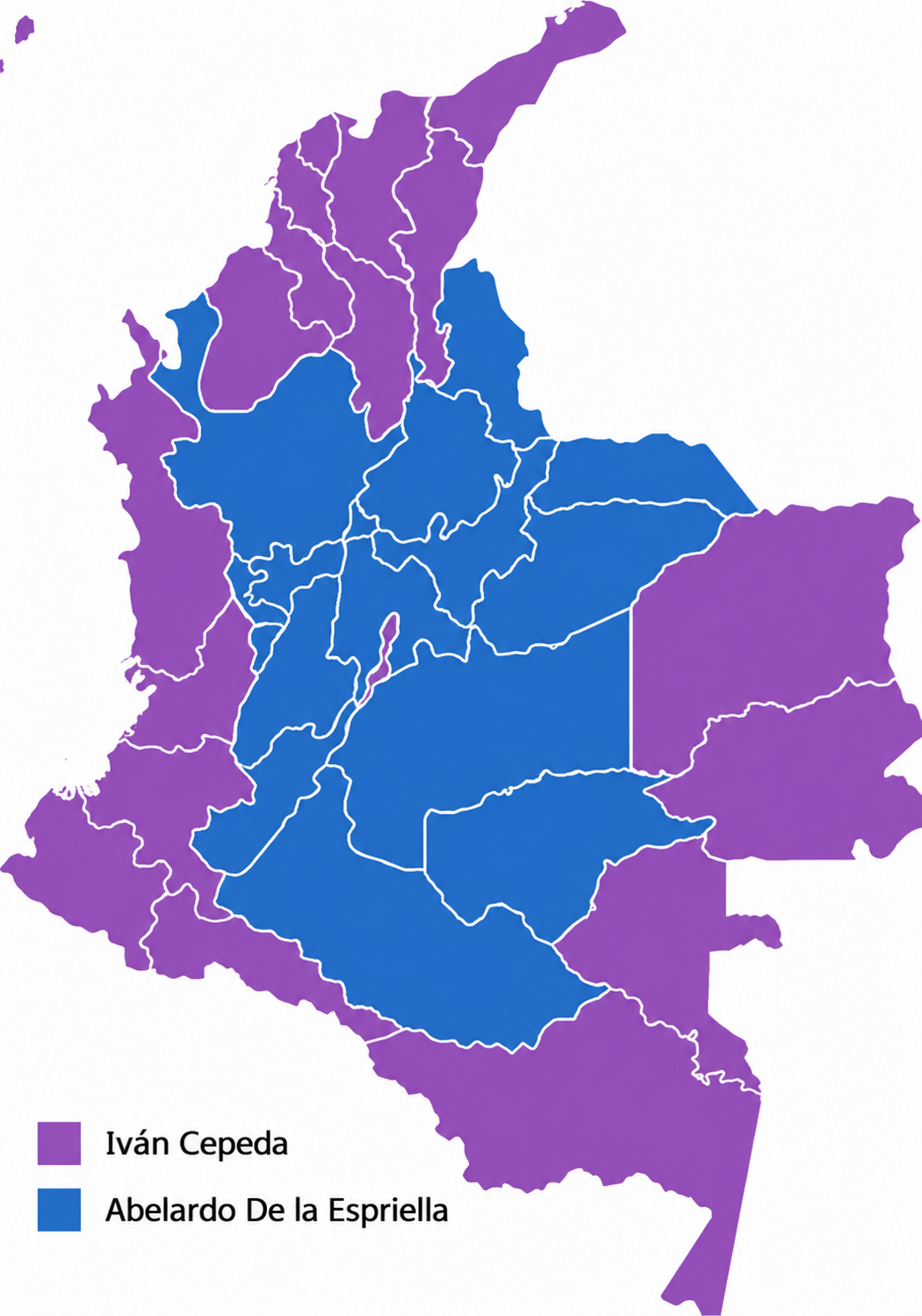
Colombia 2026 1st round top two (Graphic: Sofi Imfeld for Finance Colombia)

Colombia 2026 1st round top two (Graphic: Sofi Imfeld for Finance Colombia)

Uribe’s next handpicked candidate, Iván Duque, won the 2018 election but finished his term with approximately 30% approval. Members of his own party publicly distanced themselves from him — Senator María Fernanda Cabal, a staunch Uribista, called Duque a “mamerto” (leftist idiot) while he was still in office. Under his administration, indicators on crime and guerrilla activity worsened, and armed groups including the ELN rebuilt operational capacity that had been degraded under Uribe and Santos.

Petro’s administration has not met initial fears of a Venezuelan-style democratic breakdown: Congress has largely blocked the most radical components of his agenda, including attempts to nationalize the private pension system and convert the healthcare system to a single-payer model. However, crime has increased, armed groups have expanded their operational footprints, and the security situation in several regions has worsened. Paz Total is widely seen as having produced few tangible results.

Uribe himself was convicted of witness tampering and attempted bribery in the case he had brought against Cepeda. Though released from house arrest after conviction, the judges who authorized his release are now reportedly under investigation for judicial corruption. Valencia’s poor performance in the first round — despite being Uribe’s chosen standard-bearer — suggests that Uribismo as a political force is waning, with its core constituency aging and new generations of voters disengaged from the Uribe legacy.

What to Expect Before June 21

Both campaigns will intensify mobilization efforts over the coming three weeks. Cepeda’s movement — Colombia Humana and the broader Pacto Histórico coalition — has historically relied on organized mobilizations, including indigenous community-led mingas, labor unions, and allied social movements. Cepeda’s running mate Senator Aida Quilcué is an indigenous activist, a choice expected to energize those constituencies. FECODE, the Federación Colombiana de Trabajadores de la Educación (Colombia’s main teachers’ federation), is expected to align officially with Cepeda, though individual teachers may not follow union leadership in their voting choices.

On the right, Paloma Valencia issued a public endorsement of de la Espriella immediately following the first-round results. Business community organizations, including ANDI (the Asociación Nacional de Empresarios de Colombia) and Fenalco (the Federación Nacional de Comerciantes), do not formally endorse candidates, but their members are widely understood to favor a government that supports private enterprise and market-oriented policy. De la Espriella holds no congressional constituency, meaning whichever candidate wins will face the same dynamic Petro encountered: a fragmented Congress that is likely to act as a check on executive authority.

The question of centrist voter alignment remains open. Fajardo and López are not expected to formally endorse either finalist, and the direction of their combined approximately 1.2 million votes is uncertain.

Winners and Losers by Sector

For international investors and executives operating in Colombia, the policy differences between the two candidates are substantive across several key sectors.

Petroleum and Natural Gas: De la Espriella has stated unequivocally that he will restart petroleum exploration and licensing, which the Petro administration blocked. Ecopetrol S.A. (NYSE: EC; BVC: ECOPETROL), Colombia’s state-controlled oil company, which also holds producing assets in the US Permian Basin and Gulf of Mexico, has operated under a government that halted new drilling permits. The consequences have included a decline in future production capacity at a time when global oil prices have risen due to Middle East tensions. Colombia has been forced to import natural gas at elevated prices to meet existing domestic demand — including from transportation fleets that were converted to natural gas under government incentive programs. Cepeda would be expected to continue or deepen current restrictions on fossil fuel expansion.

Healthcare: The Petro-Cepeda platform favors a government single-payer model. The administration has already taken over several Entidades Promotoras de Salud (EPS) — Colombia’s managed-care intermediaries — placing the healthcare system in legal and financial uncertainty. Private clinics, hospitals, and physicians who wish to operate outside a government-controlled framework would benefit from a de la Espriella administration. Cepeda’s healthcare agenda would accelerate the shift toward government-managed care.

BPO, Tech, and Call Centers: The BPO sector — which provides large volumes of formal employment, particularly in Medellín, Bogotá, Cali, and Barranquilla — was significantly affected by Petro-era minimum wage increases of 16% and 23% in successive years. These increases created contract renegotiation pressures with international clients, some of whom have shifted or considered shifting operations to competing jurisdictions including Honduras, Jamaica, the Dominican Republic, Mexico, and Guatemala. At the CX Summit, the industry’s main annual event held in Cartagena, the son of Álvaro Uribe appeared as an invited keynote speaker — a gesture that could be interpreted within the industry as an implicit signal of political alignment. A de la Espriella government, with its orientation toward labor market deregulation and reduced regulatory burden, would be viewed more favorably by this sector. Current Colombian labor law prohibits part-time employment contracts and places significant restrictions on dual employment, making workforce flexibility difficult for businesses that operate outside traditional 40-hour weekly structures.

Mining: The Petro administration has been less aggressive toward mining than toward petroleum, but sector participants expect a more permissive regulatory environment under de la Espriella, and continued constraints under Cepeda.

Security and Tourism: Both candidates have stated support for tourism promotion, but the sector’s trajectory is more directly linked to security conditions. Under current policies, several regions that were accessible to domestic and international travelers several years ago have experienced increased armed-group activity, effectively closing them to tourism. A de la Espriella administration is expected to pursue a more aggressive military posture toward the ELN and FARC dissident factions; a Cepeda government would likely continue dialogue-first approaches. The outcome will directly affect which parts of Colombia’s territory remain accessible to investment and tourism.

Foreign Relations: A de la Espriella government is expected to restore a broadly cooperative relationship with the United States, which deteriorated under Petro following several high-profile diplomatic incidents. De la Espriella has expressed admiration for US President Donald Trump, and reports indicate he holds US citizenship and owns property in Florida. Relations with Ecuador, which have been strained by mutual tariff escalations between Petro and Ecuadorian President Daniel Noboa, would be expected to normalize. Relations with Venezuela under Cepeda would likely continue along the current allied trajectory, while a de la Espriella government would be expected to take a more critical posture toward Caracas. China and Russia would find a more receptive diplomatic environment under Cepeda, and a cooler one under de la Espriella.

The Poor and Informal Workers: Cepeda’s campaign argues that minimum wage increases and expanded state services benefit lower-income Colombians. Critics counter that elevated formal labor costs have pushed more employment into the informal sector — which currently accounts for approximately half the Colombian workforce — depriving those workers of pension contributions, health benefits, and job security. De la Espriella’s platform, which emphasizes business formation, security, and labor market deregulation, would be presented as generating more formal-sector job creation. The actual distributional effects of either approach remain contested.

The Outlook

Assuming current polling trends hold and Uribista voters consolidate behind de la Espriella as expected following Valencia’s endorsement, de la Espriella enters the runoff as the frontrunner. Cepeda’s path to victory depends on driving high turnout among his base, securing support from centrist voters who did not vote for either finalist in the first round, and potentially benefiting from any missteps by de la Espriella in the final three weeks of campaigning.

The first-round results produced no major electoral violence. The ELN announced a temporary halt to armed actions during the voting period. Authorities detained some individuals reportedly attempting to purchase votes in rural areas, but no large-scale incidents were recorded.

The incoming president will face a Congress with no natural majority aligned to the executive, a healthcare system in partial administrative disarray, a petroleum sector whose future production trajectory is in question, and regions where state presence remains contested by armed groups. The June 21 runoff will determine which vision — market-oriented restructuring or continuation of the Petro project — Colombia pursues for the next four years.

  •  

Venezuela Extradites Billionaire Tycoon Alex Saab to U.S.

The extradition of Alex Saab, who is tied to a huge graft scheme, is part of a purge of powerful figures who helped the deposed president, Nicolás Maduro, stay in power.
  •  

Venezuela contradicts Colombia cooperation claims about military strikes near border

Delcy Rodríguez and Gustavo Petro pictured at a meeting in Caracas in April. Image credit: Colombia President’s Office.

The Venezuelan government on Wednesday published a declaration saying it regretted recent violence in the Catatumbo region of Colombia just days after Bogotá announced bombing in cooperation with Caracas.

The statement muddies the waters about whether or not Venezuela was involved in the military operations against the National Liberation Army (ELN) rebels near the two countries’ joint border, which allegedly killed 7 guerrilla fighters. 

“The Bolivarian Republic of Venezuela expresses its profound concern and regrets the escalation of violence in the border region of Catatumbo,” read a statement shared on X by Foreign Minister Yvan Gil.

The declaration came after Colombian President Gustavo Petro said on Monday that he had ordered the bombing in cooperation with Venezuela. 

“I gave the order to bomb the ELN camp in accordance with the agreement reached with the Bolivarian government of Venezuela,” wrote Petro on X.

Petro appeared to allude to an agreement with Caracas to cooperate on tackling cross-border crime following his visit to Venezuela in April. 

But Caracas appeared to wash its hands of the recent bombing operation; while it did not directly acknowledge the bombing or Petro’s statement, its declaration said that it “rejects any armed action that compromises the peace, stability, and security of border communities.” 

It added that the only way to preserve peace and stability in the region is through “mechanisms of understanding and mutual respect, avoiding actions that can aggravate tensions or generate greater risks for border populations, who for decades have faced the consequences of a conflict out of their control.”

Since last year, Catatumbo has been the site of what has been described as “the most serious humanitarian crisis of recent times” in Colombia. In January 2025, a family of three, including a nine-month-old baby, was killed, marking the collapse of fragile peace pacts between the ELN and the Frente 33 – a dissident faction of the demobilized FARC rebels – and triggering a humanitarian crisis on a scale not seen in the country for over a decade.

The Red Cross said that 2025 was one of the most complicated years for humanitarian conditions in Colombia: more than 235,000 people were individually displaced, over 176,000 people have been unable to move freely because of armed conflict, and there has also been a sharp increase in cases of mass displacements.

Venezuela’s statement highlights the cross-border nature of the conflict, noting that the country “has historically suffered the consequences of Colombian internal conflict.” Colombian armed groups like the ELN and dissident FARC factions have traditionally had a significant presence in Venezuela and were known to have ties to the Nicolás Maduro regime.

But both the interim government under Delcy Rodríguez and Petro have been under pressure from the White House to confront guerrilla groups.

The post Venezuela contradicts Colombia cooperation claims about military strikes near border appeared first on The Bogotá Post.

  •  

Qatar Airways Set to Operate to Caracas and Bogotá flights

Qatar Airways has affirmed its expansion in the Americas with the launch of new flight operations to Caracas, Venezuela, and Bogotá, Colombia, commencing from 22 July 2026. The service represents a significant milestone for the airline, as Qatar Airways becomes the first Gulf carrier to serve Venezuela, and the first airline to operate flights from the Middle East to Caracas and Bogotá. This expansion underscores the airline’s commitment, announced last year, to strengthening global connectivity for the region.

Qatar Airways flights to Caracas (CCS) and Bogotá (BOG)

Qatar Airways will operate two weekly flights to Caracas and Bogotá, further enhancing connectivity to, and from, the Americas. The flight schedule has been designed to provide smooth onward connections through Hamad International Airport to key markets including Australia, China, Japan, Lebanon, South Korea, and the United Arab Emirates. This offers passengers greater flexibility and seamless transfer options across Qatar Airways’ global network.

Departing every Wednesday and Sunday:

  • Doha (DOH) to Bogotá (BOG) – Flight QR783: Departure 07:30; Arrival 16:05
  • Bogotá (BOG) to Caracas (CCS) – Flight QR783: Departure 17:35; Arrival 20:40
  • Caracas (CCS) to Doha (DOH) – Flight QR783 Departure 22:40; Arrival 19:55 +1

The addition of Caracas and Bogotá marks both the 15th and 16th destinations in the Americas served by Qatar Airways. The airline began serving South America in 2010 with its inaugural flight to Brazil’s São Paulo.


  •  

Petro to meet Venezuela’s Delcy Rodríguez in Caracas, focus on border security

Colombian President Gustavo Petro will meet Venezuela’s interim leader Delcy Rodríguez in Caracas on Friday to address security challenges along the shared border, marking their first official encounter since Nicolás Maduro was captured by U.S special forces on January 3, 2026.

The meeting, to be held at the Miraflores presidential palace, is expected to center on coordination between the two countries to tackle armed groups, drug trafficking and other cross-border threats that have long destabilized frontier regions.

Colombia’s presidency said the talks aim to “strengthen bilateral cooperation, territorial control and coordination on security matters,” following the cancellation of a previous meeting scheduled for March 13 at the border due to security concerns cited by Caracas.

Friday’s talks come after Rodríguez assumed power earlier this year following the capture of former Venezuelan dictator Nicolás Maduro during Operation Absolute Resolve.

Petro is expected to travel to Caracas after holding meetings earlier in Bogotá. The leaders will first hold a private discussion to outline joint actions addressing border instability, followed by a broader metting between their respective delegations aimed at formalizing institutional commitments.

Officials from both countries are also expected to sign the final act of the III Commission on Neighborhood and Integration, with foreign ministers participating, before delivering statements to the media.

The Colombia–Venezuela border stretches more than 2,200 kilometers (1,367 miles) from the Caribbean coast to the Amazon basin and has long been a hotspot for illegal activity, including the presence of the National Liberation Army (ELN) guerrilla, as well as drug trafficking and smuggling networks.

Petro said earlier this week that the talks would place particular emphasis on the Catatumbo region, one of the most volatile areas along the frontier, where violence linked to armed groups and illicit economies has intensified.

“If we go, Catatumbo is a key issue to discuss with President Delcy,” Petro said during a cabinet meeting on April 21, adding that his delegation would include military and police officials to coordinate security strategies.

He said the goal is to develop a joint security plan, improve coordination between the two countries’ armed forces and police, and deepen intelligence-sharing, warning that a lack of cooperation could lead to operations that harm civilian populations.

The meeting also comes against the backdrop of a rebound in bilateral trade between the two countries following years of strained relations.

Trade flows have increased significantly in recent years, rising from around US$200 million three years ago to more than $1 billion, representing an increase of roughly 600%, according to official figures.

Colombia recorded a trade surplus of US$1 billion with Venezuela in 2025, underscoring the economic incentives for both governments to maintain stable ties despite ongoing political uncertainties.

Petro first announced the trip last week during an interview in Spain, referencing the earlier failed meeting and signaling his willingness to travel to Caracas to advance talks.

The visit marks a key test of Colombia’s role in engaging with Venezuela’s transitional leadership, as both countries seek to stabilize their shared border while cautiously rebuilding diplomatic and economic relations in the post-Maduro era.

  •  

‘Invisible narco’ who enabled Tren de Aragua’s entry into Bogotá captured in police operation

Colombian authorities have captured the alleged crime boss “Mison,” also known as the “invisible narco”, who played a key role in facilitating the arrival of the Venezuelan criminal group Tren de Aragua in the capital Bogotá

The suspect, also known as “El Viejo,” was detained in Ecuador and handed over to Colombian authorities at the Rumichaca international border crossing under an Interpol notice, in a joint operation with Ecuadorian officials.

In Colombia, he is wanted on charges including aggravated conspiracy, homicide, drug trafficking and illegal weapons possession. A judge has ordered his pre-trial detention.

Authorities say Mison was the leader of “Los Maracuchos,” a criminal network with a strong presence in three Bogotá districts – Kennedy, Santa Fe and Los Mártires. For more than a decade, he allegedly operated under the guise of a nightlife entrepreneur, owning bars, nightclubs and informal rental properties known as “pagadiarios.”

Mayor Carlos Fernando Galán described the arrest as one of the most significant blows to organized crime in the city in recent years, calling the suspect “almost a myth” within criminal circles.

“He appeared to be a businessman in Bogotá’s nightlife economy, but in reality he was a central figure in a complex criminal structure,” Galán said.

According to investigators, the establishments he controlled served as hubs for drug distribution and were linked to serious crimes, including killings and torture. Among the venues identified by authorities are sites known as “Los Potrillos” and “Hotel Negro.”

Police also allege that Mison played a decisive role in enabling the expansion of Tren de Aragua into Bogotá around 2018, exploiting vulnerable migrant populations to recruit and train individuals for criminal activities. The group, which originated in Venezuela, has expanded across Latin America and is increasingly associated with organized crime in Colombia’s urban centers.

Bogotá Police Chief General Giovanni Cristancho said the arrest followed a two-year investigation involving cross-border cooperation. “He maintained a double life as a businessman while coordinating criminal operations,” noted Cristancho. “He was a pioneer in using ‘pagadiarios’ as operational centers to consolidate territorial control.”

Authorities said Mison fled to Ecuador in 2024 following intensified police pressure in Bogotá, where he continued operating under the cover of a merchant until his location was confirmed.

Prosecutors estimate that he accumulated assets worth more than 20 billion pesos (approximately $5 million), including rural properties, vehicles and real estate held through third parties. Officials say he generated monthly criminal revenues of up to 2 billion pesos through drug trafficking, extortion and other illicit activities.

Bogotá Security Secretary César Restrepo said the suspect’s influence extended beyond narcotics, linking him to extortion networks and contract killings.

“This is not a distant trafficker. He directly fueled violence in Bogotá and is responsible for significant harm to victims across the city,” Restrepo said.

Authorities believe the arrest will disrupt criminal structures tied to drug trafficking and urban violence, although they caution that such networks often adapt quickly.

If convicted, Mison could face a prison sentence of up to 32 years.

The operation is the latest in a series of high-profile security actions in Bogotá, as authorities seek to regain control over criminal networks and restore public safety in key areas of the capital.

Mayor Galán said the result demonstrates that sustained investigations and coordinated efforts can weaken organized crime groups.

  •  
  •  
  •  

Exiled Venezuelans may well support regime change – but diasporas don’t always reflect the politics

Protest and military action raised the prospect of regime change in Iran and Venezuela, and the voices of both countries’ diasporas were heard loud and clear through the media of their host nations.

Venezuelan exiles in the U.S. were, according to the popular narrative, broadly behind President Donald Trump and his plan to “run Venezuela,” as the nickname “MAGAzuelans” suggests. Meanwhile, the Iranian diaspora rallied behind Prince Reza Pahlavi as he positioned himself as a leader-in-waiting, projecting an image of unified exile support.

Diasporas are often treated by media and policymakers as monolithic blocs — politically unified, ideologically coherent and ready to be mobilized for regime change. But as a scholar of migration and security in Latin America, I know this assumption misunderstands how diaspora communities form, evolve and engage politically.

Iranian and Venezuelan émigrés might broadly oppose their current governments — having left them, this is unsurprising. But they are far from unified on what should replace those governments, who should lead or how change should come about.

Migration waves shape politics

Diasporas are not uniform because their constituent populations did not arrive all at once, from the same places or for the same reasons. Each migration wave carries distinct political orientations shaped by the circumstances of departure.

The tendency of diasporas to become politically frozen at the moment of departure appears across contexts. El Salvador’s diaspora in the United States, which first left during the 1980s civil war, developed a reputation for being “stuck in the ’80s” — mentally still fighting battles that had long since ended at home.

This temporal displacement has consequences. Iranian-American sociologist Asef Bayat, writing about the Iranian diaspora, argues that exile opposition to the ruling government back home “suffers from a political disease, positioning itself against the movement it claims to support.”

In other words, diaspora activists may advocate positions that resonate with Western audiences but find little support among those actually living under authoritarian rule. This lack of accountability to political consequences back home can rankle the constituencies on whose behalf they seek to advocate.

Research on the Venezuelan diaspora reflects similar dynamics. A 2022 study found that Venezuelan exiles hold more extreme anti-government views than those who remained.

Despite this presumed disconnection, homeland politicians often devote disproportionate attention to those who have left. The logic is simple: emigrants send money home — accounting for as much as 25% of gross domestic product in some Central American and Caribbean countries. Politicians assume that this financial power translates into political influence over remittance-receiving relatives.

One party official in El Salvador told me: “If we get one Salvadoran in Washington to support us, that gives us five votes in El Salvador — and it doesn’t even matter if the one in Washington votes.”

My own research tested this assumption using polling and voting data across Latin America and found it to be exaggerated. Remittances and family communication mostly reinforce existing partisan sympathies rather than swing votes.

But the belief in diaspora influence matters politically — and diaspora voters can be weaponized by authoritarian leaders. El Salvadoran President Nayib Bukele, in his successful and plainly unconstitutional 2024 reelection bid, expanded external voting through online balloting, increasing diaspora votes by 87-fold over the previous election.

Diasporas can influence home-country politics through several channels: direct voting, financial support for opposition movements, lobbying host governments and transmitting democratic values through what sociologist Peggy Levitt calls “social remittances.” Other research has found that remittances can undermine dictatorships by helping fund opposition activities.

Yet authoritarian governments have developed sophisticated countermeasures. Freedom House recorded more than 1,200 incidents of physical transnational repression against dissidents — including assassinations, abductions and unlawful deportation — between 2014 and 2024 involving 48 governments.

The limits of exile politics

For Venezuela and Iran, these lessons counsel caution. Nearly 8 million Venezuelans have fled their homeland — the largest displacement crisis in the Western Hemisphere. Iranian emigration accelerated after the 2022 protests.

Both diasporas contain passionate activists, wealthy donors and would-be leaders positioning themselves for future rule. But passion does not equal unity, and visibility does not equal representation.

The loudest voices on social media — or those amplified by U.S. officials and media — may represent narrow slices of diverse communities. There may be consensus on opposing the government back home, but far less agreement on what should be done or how change should occur.

Nor does diaspora opposition necessarily translate into regime vulnerability. Authoritarian states have learned to insulate themselves from diaspora pressure while simultaneously using emigration as a safety valve, turning potential dissidents into remittance-senders.

Diasporas can contribute to democratic change through funding, advocacy and the transmission of democratic values. But ultimately, the path to democratic change in Venezuela, Iran and elsewhere will be determined by those who remain, not those who left. Diasporas can support that struggle; they cannot substitute for it.

About the author: Michael Paarlberg is Associate Professor of Political Science at Virginia Commonwealth University.

This article is reproduced from The Conversation under a Creative Commons licence.

  •  

Global airlines return to Venezuela, Avianca restores Bogotá–Caracas flight

International airlines are rapidly re-establishing services to Venezuela, signalling a cautious but commercially significant reopening of the country’s aviation market. On Thursday, February 12, Colombia’s Avianca resumed a daily direct flights between Bogotá and Caracas.

The move restores one of the most important air corridors in northern South America and comes amid a flurry of announcements from carriers across Europe, the Americas and the Middle East seeking to regain access to a market that has been largely closed since 2019.

The flagship carrier claims that this key route was restored after a “comprehensive evaluation of operational conditions and aviation safety,” carried out in coordination with Colombian and Venezuelan authorities.

Avianca’s daily round trip flight will operate with an A320 aircraft, departing Bogotá (AV142) at 07:40 a.m. and returning from Caracas (AV143) at 12:10 p.m.

The resumption reflects the strong commercial ties between Colombia and Venezuela, as well as growing confidence among airlines that operational, regulatory and security conditions now allow for a gradual return.

For Avianca, which has operated in Venezuela for more than 60 years, the route carries both symbolic and strategic weight. The carrier said the service would strengthen regional connectivity and support trade, tourism and business travel between the two countries, which share deep economic and social ties disrupted during years of political confrontation and border closures.

Avianca’s return is part of a broader recalibration by the global aviation industry following Venezuela’s political transition and the end of Nicolás Maduro’s rule. Airlines had largely withdrawn from the country after the suspension of international flights, currency controls, safety concerns and U.S. sanctions made operations increasingly unviable.

Now, with demand for travel surging among Venezuela’s large diaspora and regional business community, carriers are moving quickly to reclaim market share — albeit cautiously, with a close eye on regulatory approvals and security assessments.

In January, American Airlines said it was ready to resume daily service to Venezuela, positioning itself as the first U.S. carrier to formally announce plans to return after nearly seven years. The airline said flights would remain subject to U.S. government approval and security evaluations, and has not yet announced a launch date.

“We have a more than 30-year history connecting Venezuelans to the U.S., and we are ready to renew that relationship,” said Nat Pieper, American’s chief commercial officer, underscoring the airline’s focus on family reunification, business travel and trade.

Before suspending operations in 2019, American was the largest U.S. airline serving Venezuela, having entered the market in 1987. The carrier said it remains in close contact with federal authorities and is working with regulators, unions and internal teams to ensure a compliant return.

While direct U.S.–Venezuela flights remain pending, regional alternatives are already expanding. Panama-based Copa Airlines has enabled ticket sales since late January allowing passengers to travel between Caracas and Miami via Panama under a single reservation, restoring a key transit option for Venezuelan travellers.

European and Latin American airlines have moved faster, with firm restart dates announced over the next six weeks. Spain’s Air Europa will resume Madrid–Caracas flights on February 17, followed by Laser Airlines the next day. LATAM Airlines plans to restart flights from Bogotá on February 23, while Colombian low-cost carrier Wingo will relaunch Medellín–Caracas services on March 1.

Further afield, Turkish Airlines will begin flights between Istanbul and Caracas on March 3, marking the return of a long-haul intercontinental connection. Spain’s low-cost Plus Ultra will also start services that same day, while Brazil’s GOL plans to resume flights from São Paulo on March 8.

TAP Portugal is scheduled to restore Lisbon–Caracas flights by the end of March.

The pace of announcements reflects both pent-up demand and a race among carriers to secure early-mover advantage in a market that, while still fragile, offers long-term potential. Venezuela’s population of more than 28 million, combined with millions of citizens living abroad, represents a sizeable base for leisure, family and humanitarian travel.

Yet challenges remain. Airlines face currency risks, infrastructure constraints and the possibility of renewed political or regulatory instability. Industry executives say most carriers are returning with limited capacity and flexible schedules, allowing them to scale operations up or down as conditions evolve.

For now, the reopening of Venezuela’s airspace is being driven less by optimism than by calculated risk-taking. Airlines are betting that gradual political normalization and the easing of restrictions will allow them to rebuild routes profitably — without repeating the costly exits of the past decade.

Avianca’s daily Bogotá–Caracas service may therefore serve as an early test case. If demand proves resilient and operations remain stable, more capacity is likely to follow. If not, airlines may once again find themselves navigating turbulence in one of Latin America’s most complex markets.

Still, after years of near-total isolation, Venezuela’s reappearance on international departure boards marks a turning point — one that global airlines are keen not to miss

  •  
  •  

Trump shows AI map with Canada, Greenland and Venezuela under U.S flag.

U.S. President Donald Trump said on Tuesday there was “no going back” on his goal to bring Greenland under U.S. control, refusing to rule out the use of force and escalating tensions with European allies already bracing for a renewed transatlantic trade dispute.

Trump’s remarks followed a series of social media posts featuring AI-generated images, including one depicting the president standing in Greenland holding a U.S. flag and another showing a map of North America with Canada, Greenland and Venezuela covered by the stars and stripes.

The imagery, shared without official explanation, has fuelled alarm among allies and raised questions about the blurring of political messaging and artificial intelligence at a moment of heightened geopolitical strain.

“As I expressed to everyone, very plainly, Greenland is imperative for National and World Security. There can be no going back — on that, everyone agrees,” Trump said after speaking with NATO Secretary General Mark Rutte.

Greenland, a vast Arctic island rich in minerals and strategically located between North America and Europe, is a self-governing territory of Denmark, a fellow NATO member. Trump’s renewed push to acquire it has revived a proposal he first floated during his previous term, but has now been accompanied by explicit warnings of tariffs and the possible use of force.

European leaders reacted with unease. Danish Prime Minister Mette Frederiksen told parliament in Copenhagen that “the worst may still lie ahead.”

“We can negotiate about everything — security, investments, the economy — but we cannot negotiate our most fundamental values: sovereignty, our country’s identity, our borders and our democracy,” Frederiksen said.

At the World Economic Forum in Davos, European Commission President Ursula von der Leyen urged the bloc to prepare for a more confrontational era.

“The seismic change we are going through today is an opportunity — in fact a necessity — to build a new form of European independence,” she said.

Trade war fears resurface

Trump has threatened steep tariffs on countries he says stand in the way of U.S. interests, including European allies involved in NATO exercises in Greenland. The European Union has warned it could retaliate with tariffs on up to €93 billion ($101 billion) of U.S. imports if trade measures are imposed.

One option under discussion is the EU’s Anti-Coercion Instrument, a powerful tool that could restrict access to public tenders, investment or services, including digital services where U.S. companies hold a surplus.

U.S. Treasury Secretary Scott Bessent sought to calm markets and dismissed fears of an escalating trade war.

“It’s been 48 hours. Sit back, relax,” Bessent told reporters in Davos. “Calm down the hysteria. Take a deep breath.”

Financial markets were less sanguine. U.S. stock index futures slid to one-month lows, global equities fell, and gold prices touched record highs as investors sought safety.

Canada and Venezuela react

The inclusion of Canada and Venezuela in the AI-generated map added to the controversy.

Canada, a close U.S. ally and NATO member, has previously been the subject of Trump’s rhetoric suggesting it could become the “51st state.” Canadian Prime Minister Mark Carney said he was “concerned” by the escalation and warned of the implications for North American and transatlantic security.

Canadian officials said Ottawa has drawn up plans to send a small contingent of soldiers to Greenland to participate in NATO military exercises, pending final approval from Carney. Canada already has aircraft and personnel deployed there as part of a NORAD exercise involving the United States.

Venezuela’s government condemned Trump’s post and called on citizens to share the country’s official map online in what officials described as a symbolic defence of sovereignty.

Russia weighs in

Russia, which has closely watched the growing rift between Washington and Europe, questioned Denmark’s sovereignty over Greenland. Foreign Minister Sergei Lavrov said the island was the result of “colonial conquest,” while denying Moscow had any designs on the territory.

Protesters also took to the streets in several European cities, including Zurich, where demonstrators carried banners opposing Trump’s appearance at Davos and denouncing what they called imperialist policies.

Despite pushback from allies and some members of Congress, Trump has shown no sign of softening his stance, leaving diplomats and markets braced for further escalation as NATO cohesion and global trade relations come under renewed strain.

  •  

Tras la llamada con Trump, Petro aumenta la presión sobre los rebeldes acusados de narcotráfico

Los expertos afirman que la determinación del presidente de Colombia de desmantelar al ELN es un reflejo tanto de las exigencias de Trump como de la frustración interna por su anterior gestión de los grupos armados.
  •  

After Trump Call, Colombia’s Petro Turns Up Heat on Far-Left Armed Group

President Gustavo Petro of Colombia is taking a harder line against the National Liberation Army, or ELN, a leftist group experts call a powerful drug trafficker in Colombia and Venezuela.
  •  

Trump hace temblar la política de América Latina

Las distintas reacciones de los países latinoamericanos a la incursión de EE. UU. en Venezuela muestran cómo el gobierno de Trump está alterando el continente.
  •  
❌